
Is there a legal maximum working temperature in the UK?
There is no legal upper limit on workplace temperature in the UK, but employers still have duties when an office or shop overheats. Here is what the law says and what it costs to fix.
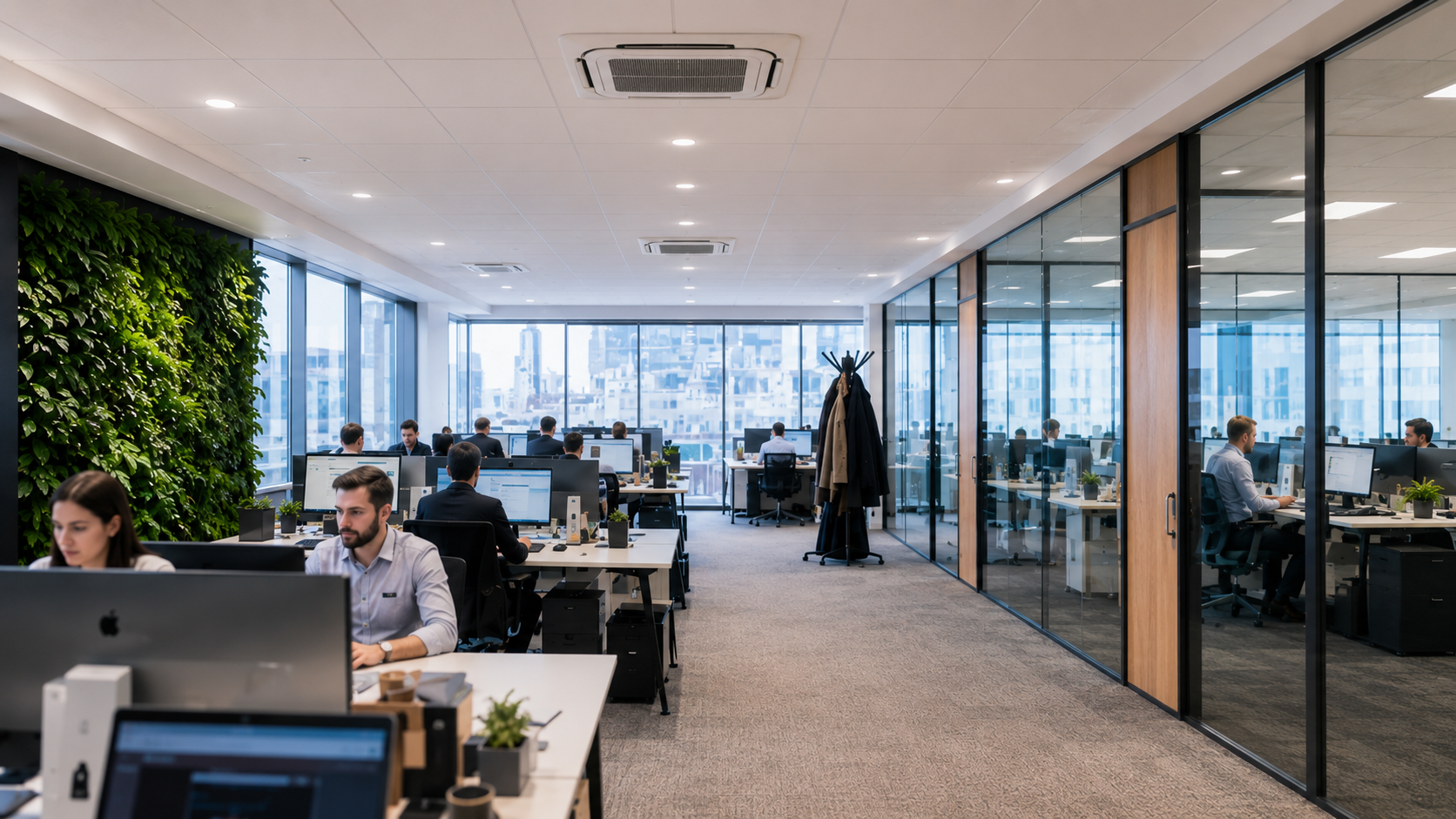
Every August the question comes up in the same three places: the staff WhatsApp group, the union rep’s inbox, and a search bar. Is there a temperature at which you are legally allowed to stop work? The short answer is no. The longer answer is more useful, because the absence of a number does not mean the absence of a duty.
What the law actually says
Indoor workplace temperature is covered by regulation 7 of the Workplace (Health, Safety and Welfare) Regulations 1992. It requires the temperature in indoor workplaces to be reasonable during working hours.
That word, reasonable, is doing all the work. The Approved Code of Practice puts a floor under it: normally at least 16 degrees, or 13 degrees where the work involves severe physical effort. There is no equivalent ceiling. No 30 degree cut-off, no legal right to walk out at a set reading on the wall thermometer.
The TUC has campaigned for years for a statutory maximum, usually proposed at 30 degrees, or 27 degrees for strenuous work. It is not law, and no government has adopted it. Anyone telling your staff that 30 degrees means everyone goes home is quoting a campaign, not a regulation.
The duty that does exist
The gap gets filled by general health and safety law. Under the Management of Health and Safety at Work Regulations 1999, an employer has to assess risks to employees and act on what the assessment shows. Heat is a risk like any other.
The Health and Safety Executive frames this as thermal comfort, and it deliberately looks past air temperature alone. Six factors decide whether a room is workable: air temperature, radiant temperature from glass and equipment, air movement, humidity, what people are wearing, and how hard they are working. A warehouse picker in a hi-vis at 26 degrees is under more strain than an accountant at 28 degrees next to an open window.
The practical trigger is complaints. Where a meaningful share of the workforce says a space is too hot, and says it repeatedly, the HSE expects a thermal comfort risk assessment rather than a shrug. It publishes a checklist for exactly this. Ignoring a documented pattern of complaints is where employers get themselves into trouble, not the temperature reading itself.
Some staff carry extra risk and need naming in the assessment: pregnant employees, people with heart or respiratory conditions, anyone on medication affecting heat regulation, and workers in PPE that cannot be removed.
What counts as taking it seriously
An assessment that ends in nothing is worse than none at all, because it documents that you knew. Reasonable steps scale with the building and the budget:
- Relaxing dress codes and allowing earlier starts during hot spells
- Moving desks away from south-facing glass
- Blinds, solar film, or external shading on the worst elevations
- Free drinking water within easy reach of every work area
- More frequent breaks for physical roles
- Fans, as a stopgap, understanding they move air rather than cool it
- Fixed cooling where the space overheats every summer
The first six are cheap and buy you a season. Only the last one fixes a building that hits 29 degrees by 2pm every July, and most employers reach it after the third consecutive summer of complaints.
The point where cooling becomes the cheaper option
The commercial case rarely rests on the law. It rests on what an overheated August does to output, sick days, and staff turnover. Cognitive performance starts slipping above 24 degrees indoors and drops sharply past 28. On a floor of ten office staff, a few percent of lost output across the hot months usually outruns the annual cost of a system.
For a single open plan area, a small office or retail unit install runs £2,500 to £4,500 fitted. A larger space needing several cassettes, or a salon or medium retail floor with heavier duty kit, sits at £5,000 to £12,000. Multi-zone systems for offices split across several rooms land between those figures depending on head count and pipe routing.
Set against the cost of one member of staff leaving, or a summer of afternoons at half pace, those brackets stop looking like a luxury purchase.
If you are the employee asking
You cannot legally down tools at a set temperature. You can raise it formally, in writing, with your employer or safety rep, and ask what the thermal comfort risk assessment says. If there is not one, that request is the thing that produces one. Collective complaints carry far more weight than individual ones, which is why the HSE guidance is written around numbers of people rather than a single grievance.
Get the space assessed properly
If your workplace overheats every summer and the fan-and-blinds approach has run out of road, get real numbers before budgeting. Tell us the floor area, the type of space, and how many people work in it on the quote form, and we will match you with commercial installers who survey the building rather than guess from square metreage. Three fixed quotes back within 24 hours.
Check the prices page for a rough bracket first, or email us a question if you want to talk it through before requesting quotes.
Ready for a real quote?
Get up to 3 fixed prices from vetted North West installers.
More on Commercial
Fitting air conditioning in a leased commercial unit
Most UK shops, salons and offices are rented, and the lease decides whether cooling can be fitted. Here is the alterations clause, the licence to alter, reinstatement risk, and what the whole thing costs.
Server room air conditioning: why comms rooms overheat and what cooling costs in 2026
A server rack pumps out heat 24 hours a day. Here is why office air con fails a comms room, what precision cooling actually needs, and what a proper UK install costs in 2026.
Gym air conditioning: what it costs and why most UK gyms get it wrong
UK gym cooling explained - why standard commercial units fail on gym floors, what a proper install costs in 2026, and the design mistakes that leave members sweating.