
Air conditioning for a conservatory: cooling the hottest room in the house
A conservatory can hit 40C on a July afternoon. Here is why standard cooling advice gets it wrong, what size unit a UK conservatory needs, and what a proper install costs in 2026.
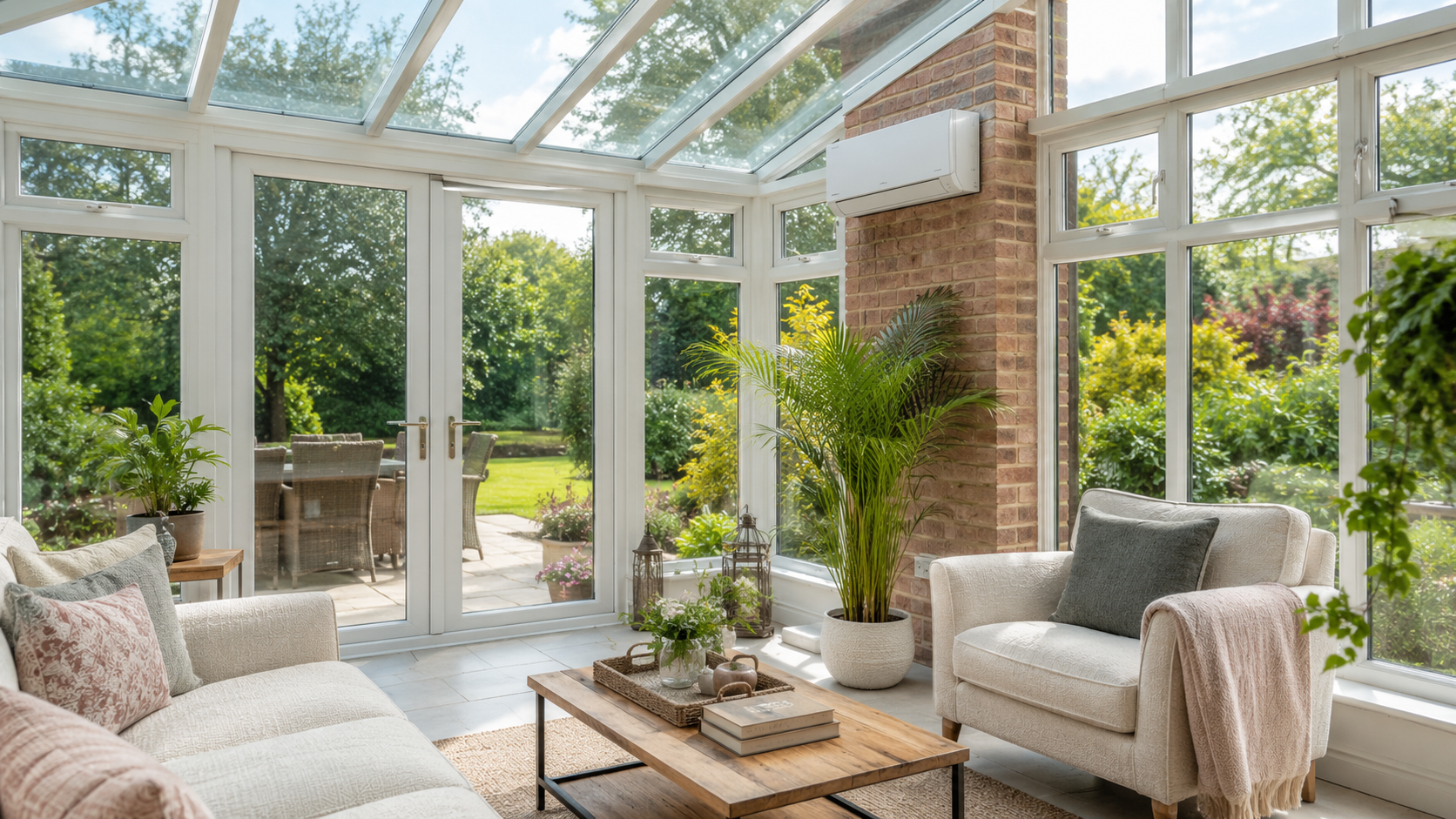
A conservatory is a greenhouse with furniture in it. On a clear July afternoon it can climb past 40C while the rest of the house sits at a comfortable 24C. That is the room most UK homeowners give up on every summer, close the door to, and stop using for three months of the year. Air conditioning is the one thing that reliably fixes it, but a conservatory is the hardest room in the house to size correctly. Get it wrong and the unit runs flat out and still loses.
Why a conservatory beats every fan and blind
People try three things first. Fans, blinds, and roof film. Each helps a little and none of them wins.
A fan moves air across your skin. It does not lower the room temperature, so a 38C conservatory with a fan is a 38C conservatory with a breeze. Blinds cut some of the solar gain if you fit them to the roof as well as the sides, but full conservatory blinds cost £1,500 to £3,000 and still leave the room warmer than the house. Solar control roof film reduces glare and takes the edge off, yet a west-facing glass roof in full sun overwhelms it.
Air conditioning is the only option that removes heat from the room rather than shuffling it around. It works the other way in winter too, which matters more for a conservatory than any other room, since a glass box loses heat fast once the sun goes down.
The sizing trap
Here is the mistake that ruins most conservatory installs. An installer sizes the unit on floor area, the way they would for a bedroom. A conservatory needs far more cooling capacity than its floor size suggests, because the heat load comes through the glass, not the footprint.
Three things drive it up:
- Glass roof and walls. Glass gains heat many times faster than a brick wall. A conservatory has glass on three sides and often the roof too.
- Orientation. A south or west-facing conservatory takes direct sun through the hottest part of the day. This alone can add half again to the cooling load.
- Poor insulation. Most conservatories have thin polycarbonate or single-glazed roofs and a solid floor that stores heat.
As a rough guide, a room that would need a 2.5kW unit as a bedroom often needs a 3.5kW or 5kW unit as a conservatory of the same floor area. Any installer who quotes a conservatory using standard bedroom sizing rules is going to undersize it. Ask directly whether their calculation accounts for the glazing and the direction the room faces.
What a good conservatory install looks like
A single wall-mounted split unit handles most domestic conservatories. The indoor head goes high on the one solid wall, usually the wall shared with the house, and the outdoor condenser sits on the ground or a bracket just outside.
The details that matter:
- Mount the indoor unit on the house wall, not the glass. You need a solid wall for the unit and the pipe run back to the condenser.
- Size for the roof, not just the walls. A glass roof is the single biggest heat source. Flag it at survey stage.
- Position the condenser out of direct sun if you can. A condenser baking in the same sun as the conservatory works harder than one in shade.
- Get the drainage right. A hard-working unit in a humid glass room produces a lot of condensate, which needs a proper route away.
For a large or wraparound conservatory, two smaller units at opposite ends beat one big unit fighting the whole space alone.
What it costs in 2026
A conservatory is a single-room install, so it sits in the same bracket as any other single room. The unit itself is usually at the larger end, which pushes it up the range.
Expect £2,200 to £3,500 fitted for a properly sized single wall unit in a standard conservatory, with a straightforward condenser location and short pipe run. That is the upper half of the single-room range on our prices page, and the premium is the bigger unit doing bigger work.
A wraparound or double-height conservatory needing two units lands closer to a two-room multi-split, £3,500 to £5,500. A tricky condenser position, a long pipe run around the house, or a listed property all add to that.
Skimping on unit size to save a few hundred pounds is the false economy here. An undersized unit runs at full power all afternoon, costs more to run, and still leaves the room warm.
The winter payback most people miss
A conservatory is the room that goes unused in both extremes. Too hot in July, too cold from October. A heat-pump air conditioning unit heats as well as cools, and it heats a glass room far cheaper than a plug-in electric heater. Fit cooling for the summer problem and you get the winter room back as well. For a lot of households that turns a three-season write-off into a room they use all year, which changes the value of the spend.
Get a conservatory sized properly
Tell us it is a conservatory in the notes on the quote form, and say which way it faces and whether the roof is glass, polycarbonate, or solid. We match you with installers who size for the glazing, not just the floor. Three fixed quotes back within 24 hours from vetted North West installers.
Or check the prices page for a rough bracket first, or email us a question if you want to talk it through before requesting quotes.
Ready for a real quote?
Get up to 3 fixed prices from vetted North West installers.
More on Guides
Air conditioning in a flat: what leaseholders need to know
Flats overheat worse than houses and carry the tightest rules on fitting cooling. Here is what your lease says, where the condenser can go, what freeholder consent costs, and the options when there is no outdoor space at all.
What temperature should you set your air conditioning?
Setting 16C does not cool a room any faster, and it costs you for the privilege. Here is the setpoint that works in a UK summer, what each degree adds to the bill, and when dry mode beats cool mode.
Air conditioning for pets: keeping dogs, cats and rabbits cool in a UK summer
Fans do far less for a panting dog than they do for you. Here is what heat does to UK pets indoors, which room to cool, what it costs to run while you are out, and when a fitted unit is worth it.