
Air conditioning in a semi-detached house: measure the side passage first
A semi is the easiest two-storey UK home to fit air conditioning in. One free flank wall takes the outdoor unit and the loft reaches every bedroom. Here is the side passage measurement that decides the job, the four condenser positions that work, and 2026 fitted prices.
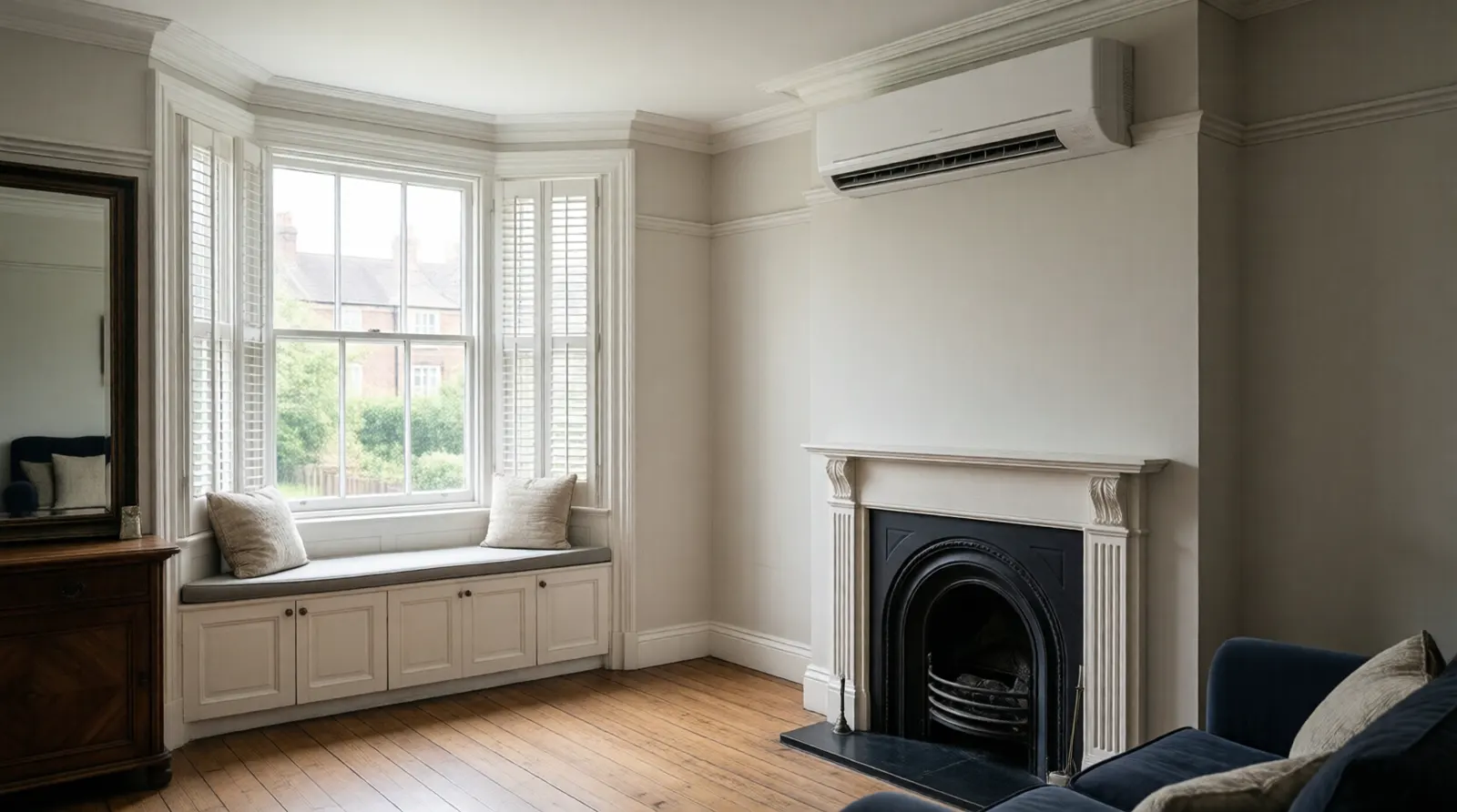
A semi-detached house is the easiest two-storey home in the UK to fit air conditioning in. One flank wall is free for the outdoor unit, the loft sits above every bedroom, and the side passage gives access without a full scaffold. Budget £1,800 to £2,800 fitted for one room and £5,500 to £8,500 for three. Before any of that, measure the side passage.
Why a semi is the straightforward job
A terrace shares two walls and opens onto a small rear yard. A semi shares one wall and keeps a free elevation down one side, so the choice of condenser position doubles.
The loft helps as much. Pipework reaches the back bedroom, the front bedroom and the box room sideways through the loft, dropping through the ceiling at the top of each wall with nothing on show. Our guide to air conditioning in a bungalow explains why that route is the cheap one.
Anything built from about 1930 onward has cavity walls, which core drill cleanly for a 65mm pipe sleeve. Pre-war semis with nine-inch solid brick take longer.
Measure the side passage first
Permitted development lets you fit an outdoor unit without an application as long as it sits at least a metre from the boundary, off any wall facing a highway, and off a pitched roof. Our planning permission guide covers all six conditions.
The metre runs from the unit casing to the boundary, not from the house wall. A condenser is about 300mm deep, brackets add 100mm, and the fan needs 200mm of clear air behind it. That is 600mm gone before you reach the fence.
So a flank wall position needs a passage of about 1.6m to clear the rule. Most 1930s and 1950s semis run 0.9m to 1.3m from brick to fence, which puts the passage out.
Measure it with a tape before you ask anyone to quote. It is the one number a phone quote never asks for.
Four condenser positions that work
- The rear elevation, high on brackets. The common answer in a semi. Back bedrooms sit two or three metres away in pipe terms, and the garden gives the metre easily.
- A ground pad where the passage opens into the back garden. The pinch point is usually at the front, beside the bay, and semis often widen at the rear corner. A level slab with feet and 200mm behind the fan does the job.
- The flat roof of an attached garage, more than a metre from the edge. It lifts noise clear of bedroom windows and shortens the run to the front of the house. Check the deck carries 40kg to 60kg and ask for a spreader frame rather than four feet on the felt.
- A rear extension or utility flat roof, on the same terms.
What does not work: the front elevation, because it faces a highway. The narrowest point of the passage, where the fan ends up 100mm off a fence. And any spot under a bedroom window, yours or next door’s.
One party wall, one quiet side
A semi has half a terrace’s noise problem and the same cause. Masonry carries vibration better than air does, so a unit bolted to the party wall can be heard clearly next door while your own garden stays quiet.
Keep brackets on your own rear elevation or the free flank, and ask for thick rubber anti-vibration mounts rather than the thin pads in the box. Modern condensers run 48 to 55 dB(A) at one metre and drop several decibels in night mode, and our guide to air con noise sets out the figures worth asking for.
One trap on the free side. A neighbour’s wall three or four metres away turns the passage into a channel, and sound bounces between two brick faces rather than dispersing. Point the fan down the garden.
Speak to the attached neighbour before the install rather than after.
Pipe runs: upstairs is easy, downstairs is not
From a rear or garage position, one riser goes up the outside wall into the loft, then separate runs cross to each bedroom. Both refrigerant lines need full-length lagging through an unheated loft, or bare pipe sweats in summer and drips onto the insulation.
Downstairs is the awkward half of a semi, which surprises people. The lounge has no void above it, so the run comes down the outside wall and in behind the unit, or gets chased along a ceiling and boxed in a corner. Many semis use the stairs bulkhead or the airing cupboard. Settle it at the survey, not on the day.
Condensate needs a steady fall to a gully or a soil stack with a trap. Where the fall is not there, a small pump adds £80 to £150.
The rooms that run hot in a semi
The front bedroom over the bay is usually the worst room in the house. It sits above a warm lounge, takes the afternoon sun through three faces of glass, and loses its cross ventilation the moment the window shuts against road noise.
The box room over the hall comes next, now that most of them are home offices. Our post on air conditioning for a home office covers that case.
Check sizing with our BTU calculator. A 13 square metre front bedroom with a west-facing bay comes out near 1.6kW, so a 2.0kW unit fits. A knocked-through lounge diner of 28 square metres lands near 3.4kW and wants a 3.5kW head, not the 2.5kW a floor-area rule of thumb suggests. Our guide on which rooms to prioritise sets the order for a whole house.
2026 fitted prices
One wall unit sits in the single-room bracket on our prices page: £1,800 to £2,800 fitted, including VAT. A semi usually lands mid-bracket, because the rear or garage position is simple but the pipe run is longer than a bungalow’s.
Two heads sharing one outdoor unit, commonly the front bedroom and the lounge, come to £3,500 to £5,500. Three rooms run £5,500 to £8,500, which covers most three-bedroom semis done in one visit. Four heads come to £7,500 to £11,500.
Where the condenser goes high on a rear wall and no tower fits down the passage, allow a few hundred pounds for access.
Book while the diaries are clear
October to February is the quiet half of the installer year, and a semi with a tight passage gets measured properly in that window rather than squeezed between heatwave callouts in July. Our guide on the best time to install air conditioning explains how demand moves.
Tell us on the quote form which rooms you want cooled, the width of the side passage, and whether there is a garage or extension with a flat roof. Up to three vetted North West installers survey and come back with a fixed price within 24 hours.
Check the prices page for a bracket first, or email us if you want a condenser position checked before you book.
Common questions
Can you fit air conditioning in a semi-detached house?+
Yes, and a semi is the easiest two-storey house type to do it in. One side elevation is free for the outdoor unit, the loft sits above every bedroom for pipe runs, and the side passage gives access for brackets at first-floor height without a full scaffold.
How much does air conditioning cost in a semi-detached house?+
£1,800 to £2,800 fitted for one room, including VAT. Two rooms sharing one outdoor unit come to £3,500 to £5,500, and three rooms to £5,500 to £8,500, which is where most three-bedroom semis land when the whole house goes in at once.
How wide does the side passage need to be for an outdoor unit?+
Permitted development asks for a metre from the boundary, and a condenser plus brackets plus clear air behind the fan uses about 600mm. A passage of 1.6m or more works. Most 1930s semis have 0.9m to 1.3m, so the unit goes on the rear wall or a garage roof instead.
Can the outdoor unit go on the party wall side of a semi?+
Keep brackets off the party wall and off the flank that faces the attached neighbour. Masonry carries vibration into the next house. Use your own rear elevation or free flank, fit thick anti-vibration mounts, and point the fan down the garden.
Ready for a real quote?
Get up to 3 fixed prices from vetted North West installers.
Air conditioning quotes near you
Local price guides and installer coverage across the North West.
More on Guides
Can you take air conditioning with you when you move house?
A fitted split system counts as a fixture, so it stays with the house unless you exclude it in writing before contracts. Here is what a strip-out and refit really costs against a fresh install, why the warranty does not travel, why the old pipework rarely fits the next house, and what to check if you are buying a home that already has air con.
Does air conditioning affect your home insurance?
A fitted split system rarely moves your premium, but it does belong on your insurer's record. Here is why a wall-mounted condenser is usually covered as part of the building while a ground-mounted one may not be, what the property in the open limit means, which paperwork settles a claim, and how much an install adds to your rebuild figure.
Can you buy your own air conditioning unit and pay someone to fit it?
Some installers will fit a unit you supplied. Most refuse, and the ones who agree charge a labour-only rate that leaves you £200 to £500 ahead on a job that costs £1,800 to £2,800 fitted. Here is why installers say no, what the November sale listings hide, and the one case where supply-only genuinely works.