
How to size air conditioning for a room (BTU guide)
How to size the right air conditioning unit for a UK room - BTU calculation, watts to BTU conversion, and the room-by-room rules that installers actually use.
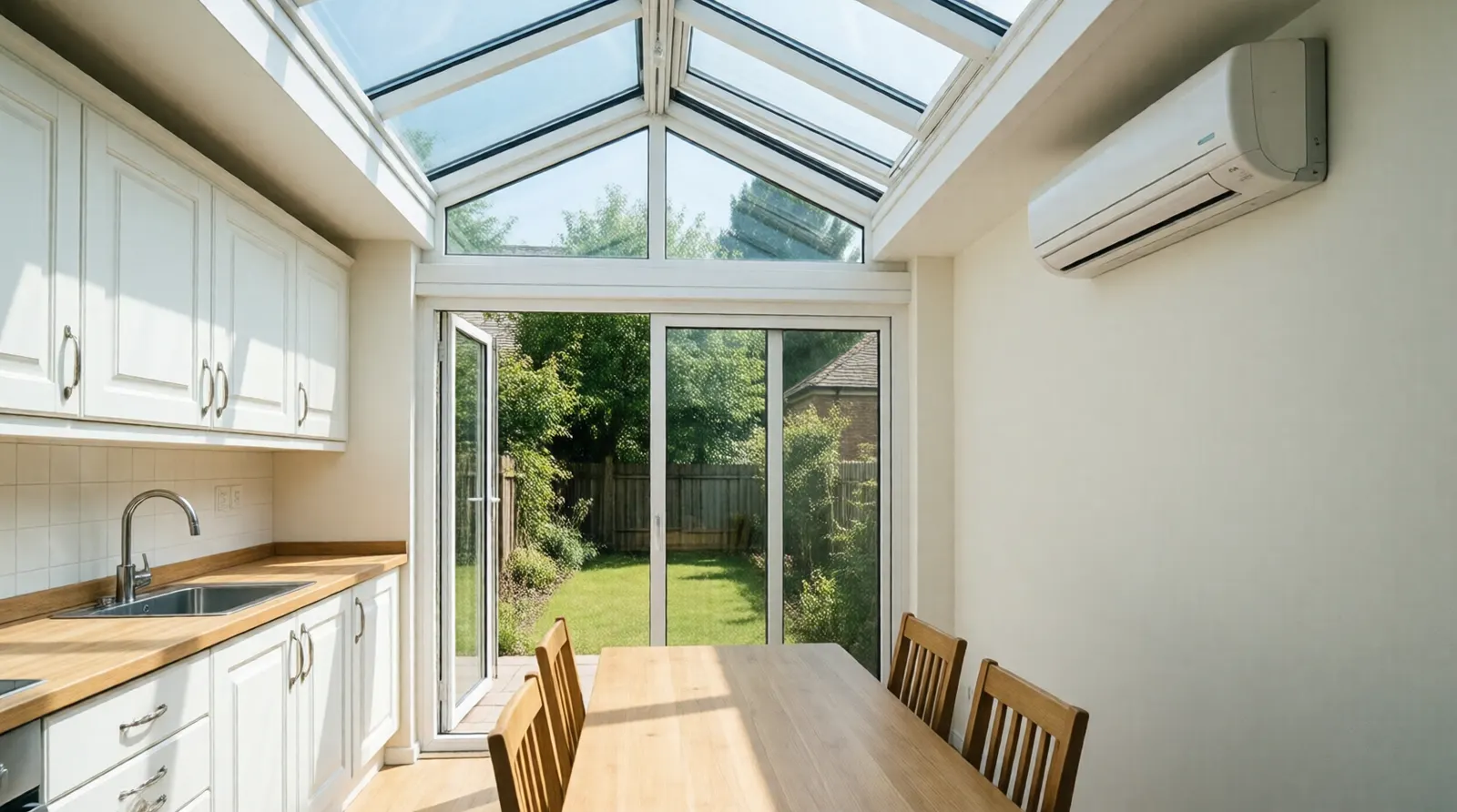
An air conditioner that is too small runs constantly and never quite cools the room. One that is too big cools too fast, cycles on and off, and leaves the room humid. Sizing matters. Here is how installers do it.
The rough rule of thumb
For a typical UK room with a 2.4 metre ceiling, allow about 0.1 kW of cooling per square metre. That gives:
- Small bedroom or home office (10 to 15 sq metres): 1 to 1.5 kW needed, so a 2 kW (7,000 BTU) unit, the smallest common size
- Standard bedroom (15 to 20 sq metres): 1.5 to 2 kW, so a 2 kW (7,000 BTU) unit, or 2.5 kW (9,000 BTU) if the room is sunny
- Living room (20 to 30 sq metres): 2 to 3 kW, so a 2.5 kW (9,000 BTU) or 3.5 kW (12,000 BTU) unit
- Big open-plan lounge or kitchen-diner (30 to 45 sq metres): 3 to 4.5 kW, so a 3.5 to 5 kW (12,000 to 18,000 BTU) unit, and more if the kitchen is in the room
BTU/hr and kW convert like this: 1 kW cooling equals about 3,412 BTU/hr. So a “2.5 kW split unit” is a “9,000 BTU unit” - same thing, two labels.
Want the number for your own room? Our BTU calculator does the sums below for you, room by room.
The formula installers start from
The rule of thumb works for a typical room. If your room is unusual (huge windows, south-facing, high ceiling, loft room) the adjustments matter. This is the method in Daikin UK’s sizing guide:
- Base: floor area in square metres x 0.1 kW, for a room with a 2.4 metre ceiling. That is about 341 BTU per hour per square metre.
- Taller ceiling: increase in proportion. A 2.7 metre ceiling holds 12.5% more air, so add 12.5%.
- South- or west-facing windows: add 10 to 20%.
- Kitchen: add 10 to 20% for the heat from cooking.
- More than two people regularly in the room: add about 0.18 kW for each extra person.
- Loft rooms and older, draughty rooms run hotter: add around 15%.
Example: a 4 metre by 5 metre living room, south-facing with big windows, a 2.7 metre ceiling, and a family of four there most evenings.
- Base: 20 sq m x 0.1 kW = 2.0 kW
- 2.7 metre ceiling, +12.5%: 2.25 kW
- South-facing with big windows, +20%: 2.70 kW
- Two people over the first two, +0.36 kW: 3.06 kW
That is about 10,400 BTU per hour, so the next standard size up is a 3.5 kW (12,000 BTU) unit. The formula gets you to the right size in most rooms, and your installer confirms it on the survey.
The three sizing mistakes we see
- Sizing for cooling only when you want heating too. If the unit will be a main source of winter heat, the installer needs to work out the room’s heat loss and check the unit’s heating output at low outdoor temperatures. The cooling size on its own does not answer that.
- Sizing for peak demand. A single hot week does not justify an oversized unit for the rest of the year. Better to size for typical hot summer conditions and accept the room stays at 22 not 20 on the worst day.
- Sizing per room in a multi-room install without checking the outdoor unit. Multi-split systems have a total-capacity limit. Two 9,000 BTU indoor heads sharing an outdoor unit rated for 12,000 BTU will never both run at full output.
What “BTU” means when the label says kW
Every UK-sold unit lists both figures. The BTU number is the imperial/US standard. The kW number is the metric standard. They mean the same thing - cooling capacity in an hour.
Nominal cooling capacity is the “at 35 degrees outside” number. Cooling drops off as it gets hotter outside. A 3.5 kW nominal unit produces about 3.2 kW at 42 degrees outside. Fine in a UK summer.
Heating capacity is a separate number. Many budget units heat at 80% of their cooling capacity - a 2.5 kW cooling unit only heats at 2 kW. Premium units heat at 100%+ of the cooling rating.
Rule of thumb we use in practice
- Small bedroom or home office: a 2 kW (7,000 BTU) unit covers most. Go to 2.5 kW (9,000 BTU) if the room is sunny or in the loft.
- Living room: 2.5 kW (9,000 BTU) suits up to about 25 sq metres and 3.5 kW (12,000 BTU) up to about 35 sq metres, a little less in a sunny south- or west-facing room.
- Multi-room install: size each room, then let the installer size the outdoor unit for the whole house.
Get an installer to size the room for you
Every survey a Cooler Spaces installer does includes a proper BTU calculation for each room. That is what they are trained for. If you specify a room size and get a quote without a survey, that quote is a guess.
Fill in the quote form with your rooms and rough sizes. Three fixed quotes back within 24 hours, each with a proper capacity calculation.
Or check the prices page for a rough bracket first.
Ready for a real quote?
Get up to 3 fixed prices from vetted North West installers.
Air conditioning quotes near you
Local price guides and installer coverage across the North West.
More on Guides
Can you take air conditioning with you when you move house?
A fitted split system counts as a fixture, so it stays with the house unless you exclude it in writing before contracts. Here is what a strip-out and refit really costs against a fresh install, why the warranty does not travel, why the old pipework rarely fits the next house, and what to check if you are buying a home that already has air con.
Does air conditioning affect your home insurance?
A fitted split system rarely moves your premium, but it does belong on your insurer's record. Here is why a wall-mounted condenser is usually covered as part of the building while a ground-mounted one may not be, what the property in the open limit means, which paperwork settles a claim, and how much an install adds to your rebuild figure.
Can you buy your own air conditioning unit and pay someone to fit it?
Some installers will fit a unit you supplied. Most refuse, and the ones who agree charge a labour-only rate that leaves you £200 to £500 ahead on a job that costs £1,800 to £2,800 fitted. Here is why installers say no, what the November sale listings hide, and the one case where supply-only genuinely works.