
Can you control air conditioning from your phone?
Nearly every split system sold in the UK takes app control, either built into the indoor unit or through a wifi module that clips inside it. Here is what the app does that the handset cannot, what the module costs, which brands talk to Alexa, Google Home and Apple Home, and why the heating season is where phone control earns its keep.
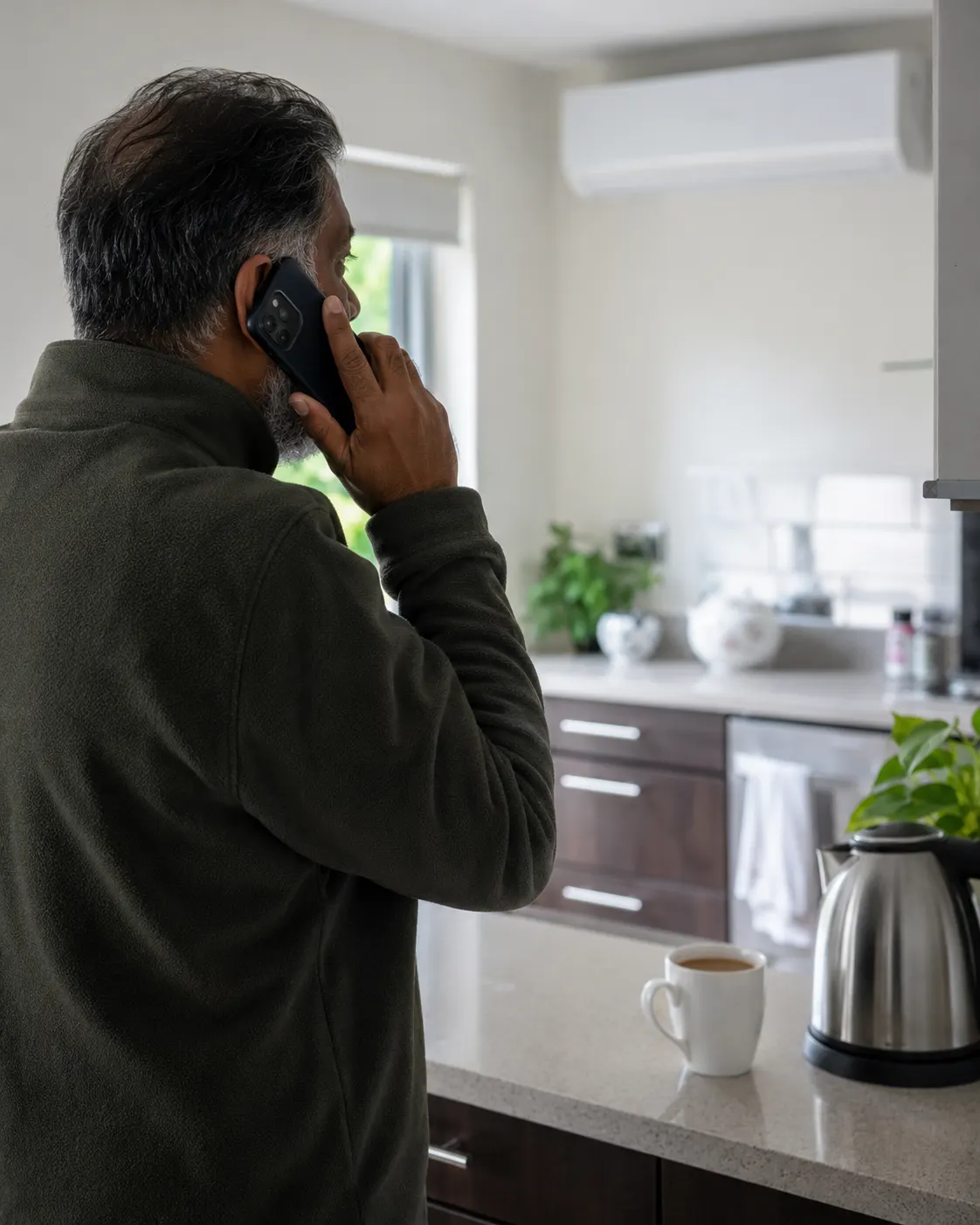
Yes, and on most new systems the hardware is already in the box. Every major brand sold in the UK runs an app, so the handset on the wall becomes the backup rather than the main control. The question worth asking is not whether your unit can do it, but whether the module gets fitted on install day or forgotten until you want a second visit.
Built in, or a module that clips inside
Two routes get an indoor unit onto your wifi.
Some 2026 models arrive with wifi built in. You power up, open the app, scan the QR code on the unit and you are done.
The rest take a small module that plugs into a port behind the front panel of the indoor unit. Daikin, Mitsubishi Electric, Panasonic, LG, Samsung, Toshiba and Fujitsu all sell one for their domestic range. The part costs £50 to £150. An installer fits and commissions it in the time it takes to finish the paperwork, which is why it belongs on the quote rather than on a shopping list for later.
Two practical points. Nearly every module runs on 2.4GHz wifi only, so a 5GHz-only network or a mesh node that hides the 2.4GHz band will refuse to pair. And the signal has to reach the indoor unit, which often sits high on an internal wall at the far end of the house from the router. Our install day guide covers where the unit ends up.
What the app does that the handset cannot
The remote handles temperature, mode and fan speed. So does the app. The gap is everything else.
- Schedules by day. Heat the home office to 21C from 8am to 5pm on weekdays, nothing at weekends.
- Control from outside the house. Start the living room from the car on a cold Friday, or switch off the unit a visitor left running.
- Room by room on a multi-split. Each head appears separately, so the spare bedroom stays off while the main bedroom runs.
- An energy estimate. Most brand apps chart consumption by day and week. Treat it as an estimate rather than a meter reading, though the shape of the chart tells you which room costs you money.
- A frost setting for a holiday. Hold an empty house at 10C through a cold snap for a few pence a day.
- An error code on screen. If the unit stops, you can read the code to an installer over the phone instead of describing a blinking light.
Alexa, Google Home and Apple Home
Daikin, Mitsubishi Electric, Panasonic, LG and Samsung publish skills for Alexa and Google Home. Linking takes a minute in the app, and voice then covers the basics: set a temperature, switch a room off, turn heating on in the nursery.
Apple Home is patchier. Few brands support it directly, so most people get there through a third-party controller. Matter support is arriving brand by brand, so do not buy a unit today on the promise of it.
Voice suits one-off commands. The schedule still belongs in the brand app.
Older units and infrared controllers
If your system predates app control, or the module for it was discontinued, an infrared controller does most of the job. A Sensibo or Tado unit sits on the wall opposite the indoor unit, learns the handset’s commands and fires them back over infrared. They cost £80 to £150 and work with almost any split that came with a remote.
The trade-off is feedback. The controller knows what it last told the unit, not what the unit is doing, so a handset picked up by someone else leaves the app out of step. Scheduling and remote control work well. Energy reporting does not.
Does it actually save money
Not per hour. A 2.5kW split costs 18p to 24p an hour cooling on a hot day and 12p to 18p an hour on heat mode on a mild autumn evening, at 24p per kWh, whether a phone or a thumb sets it. Our cost per hour guide has the full table.
The saving comes from the hours you no longer run. Three patterns are worth setting up:
- A weekday schedule. Heating an empty room from 9am to 4pm is the single most expensive habit app control fixes.
- A short pre-heat. Twenty minutes before you get home beats both a cold room and a unit left on since breakfast.
- A sensible setpoint, locked in. A schedule that calls for 21C stops the 26C guesses. Our guide on what temperature to set explains why a lower number does not heat or cool any faster.
Heat mode is where this adds up, because the system runs for months rather than a fortnight. Our heating running costs guide sets out the figures against gas.
Set the schedule before the clocks go back
October is the month to do this. The heating season runs from now until March, and a schedule written in the first cold week saves you fiddling with the handset every evening until spring.
Start simple. One morning block, one evening block, a lower overnight setting, and a weekend pattern. Give it a fortnight, then adjust the start times by the half hour until the room is comfortable when you walk into it.
What to ask before you book
- Is the wifi module included in the price, or listed separately?
- Will the engineer fit and commission it on the day, and pair it to the app before leaving?
- Does our router reach the indoor unit on 2.4GHz?
- Whose email address owns the account? It should be yours, not the installer’s.
Add those to the list in our 12 questions to ask an installer.
A single room split runs £1,800 to £2,800 fitted including VAT on our prices page, with two rooms at £3,500 to £5,500 and three at £5,500 to £8,500. A wifi module sits inside those brackets on most quotes. Ask, so you know.
Tell us on the quote form which rooms you want to run on a schedule and whether anyone in the house uses Alexa, Google Home or Apple Home. Up to three vetted North West installers survey and come back with a fixed price within 24 hours.
Check the prices page for a bracket first, or email us if you want the app and module question checked against the unit you have in mind.
Common questions
Can you control air conditioning from your phone?+
Yes. Every major brand sold in the UK has an app: Daikin Onecta, Mitsubishi Electric MELCloud, Panasonic Comfort Cloud, LG ThinQ, Samsung SmartThings, Toshiba and Fujitsu. Some 2026 indoor units have wifi built in. The rest take a module that clips into a port inside the casing, which an installer fits in a few minutes on install day.
How much does a wifi module cost for air conditioning?+
£50 to £150 for the module, depending on brand. Fitted during the install it adds almost nothing in labour. Booking a separate visit later costs far more than the part, so decide before the engineer arrives.
Does air conditioning work with Alexa or Google Home?+
Daikin, Mitsubishi Electric, Panasonic, LG and Samsung all publish Alexa and Google Home skills, so voice commands set temperature and mode. Apple Home support is thinner and usually needs a bridge such as a Sensibo or Tado controller.
Can I control my air conditioning when I am out?+
Yes. The module talks to the brand's cloud account over your home broadband, so the app works from anywhere with a signal. Two things break it: a router outage at home, and a unit sited where the 2.4GHz wifi does not reach.
Does app control cut running costs?+
It cuts waste rather than the cost per hour. A schedule stops a room heating at 2pm when the house is empty, and a 20 minute pre-heat before you get home beats leaving the unit on all day. The module itself draws about 2W, under £5 a year.
Ready for a real quote?
Get up to 3 fixed prices from vetted North West installers.
Air conditioning quotes near you
Local price guides and installer coverage across the North West.
More on Guides
Can you take air conditioning with you when you move house?
A fitted split system counts as a fixture, so it stays with the house unless you exclude it in writing before contracts. Here is what a strip-out and refit really costs against a fresh install, why the warranty does not travel, why the old pipework rarely fits the next house, and what to check if you are buying a home that already has air con.
Does air conditioning affect your home insurance?
A fitted split system rarely moves your premium, but it does belong on your insurer's record. Here is why a wall-mounted condenser is usually covered as part of the building while a ground-mounted one may not be, what the property in the open limit means, which paperwork settles a claim, and how much an install adds to your rebuild figure.
Can you buy your own air conditioning unit and pay someone to fit it?
Some installers will fit a unit you supplied. Most refuse, and the ones who agree charge a labour-only rate that leaves you £200 to £500 ahead on a job that costs £1,800 to £2,800 fitted. Here is why installers say no, what the November sale listings hide, and the one case where supply-only genuinely works.