
What temperature should you set your air conditioning?
Setting 16C does not cool a room any faster, and it costs you for the privilege. Here is the setpoint that works in a UK summer, what each degree adds to the bill, and when dry mode beats cool mode.
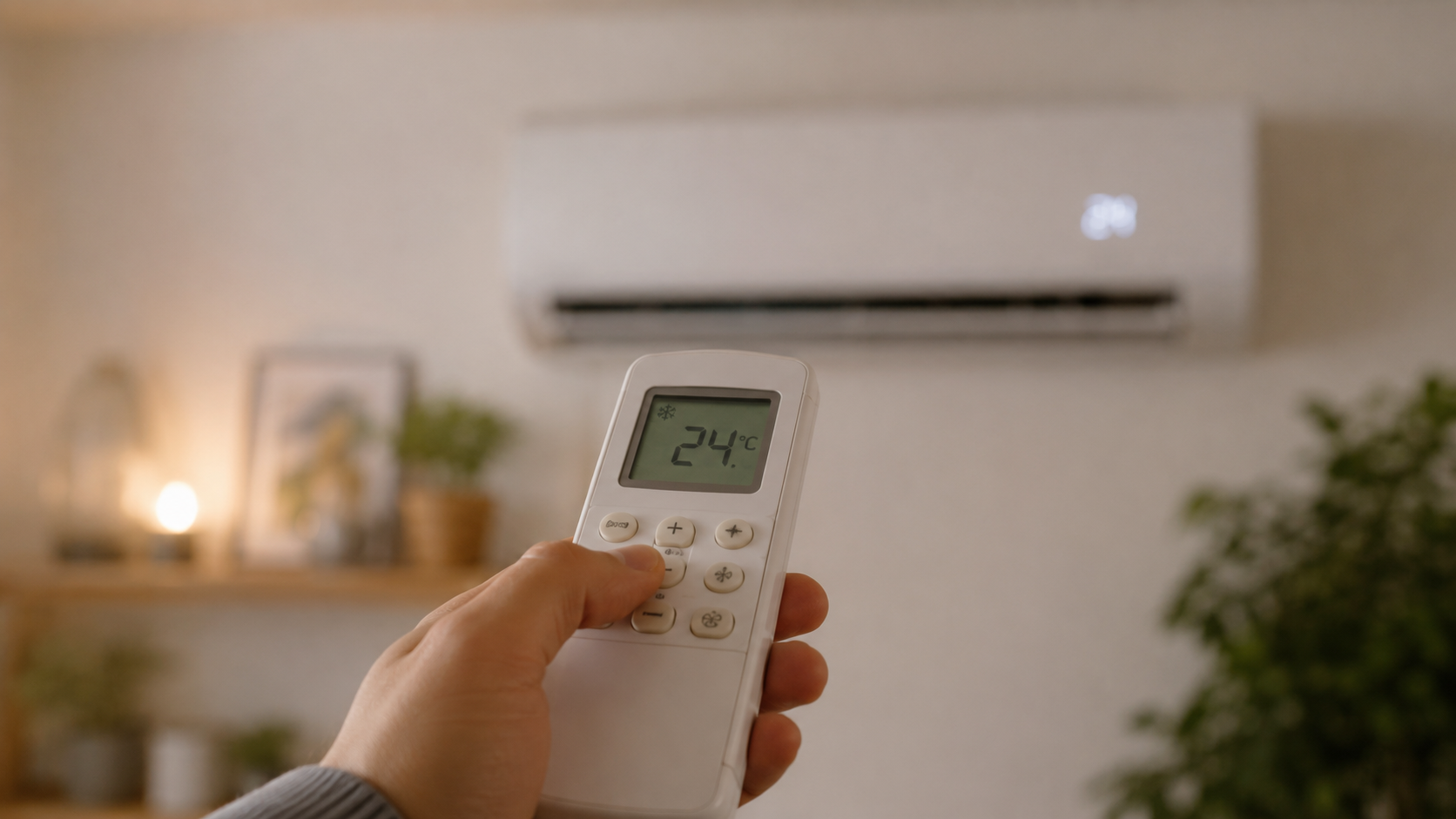
It is the fourth hot day in a row. The living room is sitting at 28C, someone picks up the remote, and the first thing they do is hold the down arrow until it reads 16. Then they stand in front of the unit waiting for the room to change.
It will not change any faster. That is the single most common misunderstanding about air conditioning in British homes, and it costs people money every summer.
The short answer
Set it to 22C to 24C on a hot day. Most UK households land on 23C for living rooms and 22C overnight in bedrooms.
That will feel colder than it sounds. When the outside air is 30C and your body has spent the afternoon in it, a room at 23C feels genuinely cold for the first ten minutes. Give it a quarter of an hour before you reach for the remote again.
Why 16C does not cool the room faster
The setpoint tells the unit where to stop, not how hard to work getting there. Think of it as the destination rather than the accelerator.
Set 23C and the unit runs flat out until the room hits 23C, then throttles back and holds it. Set 16C and the unit runs flat out to 23C at exactly the same speed, sails straight past it, and keeps going. You get the same first fifteen minutes and then a room that ends up too cold, with the compressor working the whole time to keep it there.
The thing that does change the speed is fan speed. Put the fan on high and the cooled air reaches the far corner of the room sooner. Drop it to low once you are comfortable, because low fan is quieter and pulls more moisture out of the air.
What each degree costs
At the current Ofgem cap of 24p per kWh, a 2.5kW split cooling a bedroom costs 18p to 24p an hour on a hot day. The full breakdown by room size sits in our cost per hour guide.
The setpoint moves that figure more than anything else you control. Running at 18C rather than 22C can push a session up by a third to a half, because the unit spends far more of the hour with the compressor on rather than idling. Once the room is at setpoint and holding, a split drops to 1p or 2p an hour.
There is a comfort argument as well as a cost one. Walking from a 30C garden into a 17C room is a shock, and a gap of more than about 8C between inside and outside is where people start complaining of headaches and stiff shoulders. Keep the difference sensible.
Bedrooms and sleep
Sleep guidance in the UK puts the ideal bedroom somewhere between 16C and 18C. Chasing that with air conditioning all night is expensive and usually draughty.
What works better: cool the room to 21C or 22C before bed with the fan on high, then switch to night mode. Night mode drops the fan to its quietest speed and lets the setpoint drift up by a degree or two over several hours, which matches the way your body temperature moves anyway. A bedroom-grade unit runs at 19dB to 22dB on that setting, quieter than a fridge. Our quietest units guide covers which models hold that figure.
Nurseries are the exception. Safe sleeping advice puts a baby’s room at 16C to 20C, and the positioning matters as much as the number. We covered both in air conditioning for a nursery.
Dry mode, auto and cool
Most UK discomfort in August is humidity rather than raw heat. A muggy 24C evening after rain feels worse than a dry 27C afternoon.
Dry mode targets that. The unit runs the compressor in short, gentle cycles to condense moisture out of the air without dropping the temperature much, and it draws less power than full cool mode. On a close, sticky night it is often the better setting. A domestic split pulls roughly one to two litres of water an hour out of a room.
Cool mode is the right choice when the room is genuinely hot. Dry mode will not rescue a south-facing bedroom at 29C.
Auto mode picks between the two based on the room sensor. It works well in a normal room and badly in a conservatory or a room with a lot of glass, where the sensor in the indoor unit reads something very different from the temperature by the window. Our conservatory guide explains why those rooms behave differently.
Timers beat leaving it running
Almost every unit sold now has app control. Starting the system from the train at 5pm costs less than leaving it running since 8am, and less than fighting a 29C room from scratch at six.
Modern splits bring a room down in eight to twelve minutes, so turn it off when the room is empty. The main case for running it all day is a pet at home, which we looked at in air conditioning for pets.
The winter setting
The same unit heats, and the same rule applies. Set 20C to 21C for heating and leave it there. A higher setpoint does not warm the room faster, it just extends the runtime. Skip the boost or turbo button unless you want a burst of warmth for ten minutes.
Air conditioning in heat mode delivers around three units of heat per unit of electricity, which is why it undercuts electric heaters on a room-by-room basis. The numbers are in winter warmth from an air conditioner.
When the setting is not the problem
If the room never reaches 23C on a hot day, no setpoint will fix it. Three usual causes: the unit is undersized for the room, the filters are clogged with dust, or the room gains heat faster than the system removes it through unshaded glass.
Sizing is the one that costs money to get wrong. A 2.5kW unit in a 30 square metre lounge will run continuously and never quite win. Our BTU sizing guide sets out the calculation installers use.
Get quotes from installers who size it properly
Tell us on the quote form which rooms you want cooled, their rough dimensions, and which way they face. Installers can then size the system to hold 23C on the hottest day of the year rather than the average one. Three fixed quotes back within 24 hours from vetted North West installers.
Or check the prices page for a rough bracket first, or email us a question if you want to talk it through before requesting quotes.
Ready for a real quote?
Get up to 3 fixed prices from vetted North West installers.
More on Guides
Air conditioning in a flat: what leaseholders need to know
Flats overheat worse than houses and carry the tightest rules on fitting cooling. Here is what your lease says, where the condenser can go, what freeholder consent costs, and the options when there is no outdoor space at all.
Air conditioning for pets: keeping dogs, cats and rabbits cool in a UK summer
Fans do far less for a panting dog than they do for you. Here is what heat does to UK pets indoors, which room to cool, what it costs to run while you are out, and when a fitted unit is worth it.
Does air conditioning add value to a UK home?
Nobody can point to a reliable percentage uplift, so here is what air conditioning really does to a UK house sale, which homes gain most, and the install choices that protect value rather than dent it.