
Does air conditioning stop condensation and damp?
Condensation season starts in late September. Air con pulls litres of water out of a room and keeps cold surfaces warm, but it fixes nothing structural. What it does, what it will not touch, and how it compares to a dehumidifier.
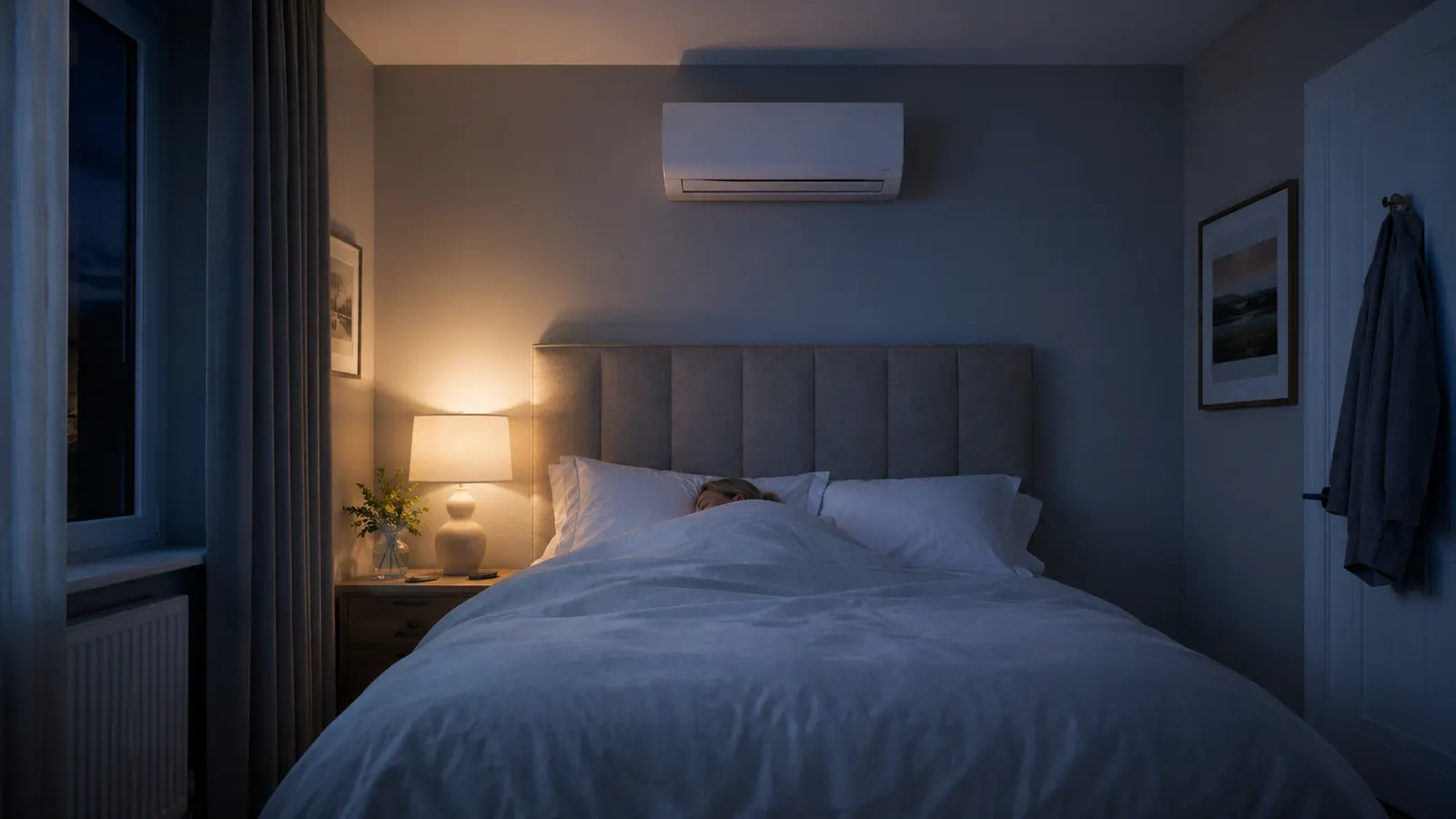
The first cold morning of the year arrives in the last week of September. You pull the curtains and the bedroom window is running with water. By half term there is a grey bloom in the corner behind the wardrobe.
Search for a fix and air conditioning comes up. It does help with some of this. It will do nothing at all for the rest. Here is the line between the two.
Why the water appears now, not in August
Air holds moisture. Warm air holds more of it than cold air. Cool a patch of air far enough and it gives that moisture up as liquid, on whatever surface cooled it. That temperature is the dew point.
Through summer your windows sit at 18C or 20C overnight, well above the dew point of the air in the room. From late September the glass drops to 10C or lower before dawn. The room air is still warm and moist, so the glass takes the water.
A household of four puts 10 to 15 litres of moisture into the air every day. Two adults asleep for eight hours breathe out about a litre between them. A shower adds half a litre. A load of washing dried on an airer adds two litres over a day, all of it into the room.
Nothing in the house has changed. The surfaces got cold.
What a split system does to the moisture
A fitted air conditioner runs room air over a coil that sits below the dew point. Water condenses on that coil, collects in a tray, and leaves through a drain pipe to the outside. This is not a feature bolted on. It is how the machine works in cooling mode.
A domestic split pulls roughly one to two litres of water an hour out of a room while it cools. Dry mode targets the same job at lower power, running the compressor in short cycles to strip moisture without dropping the temperature much. We covered the settings in our guide to what temperature to set your air conditioning.
The second half matters more in autumn. Running the unit in heating mode raises the temperature of the walls and glass. Warm surfaces sit above the dew point, so the moisture stays in the air rather than settling. A cold spare room heated for two hours in the evening stops growing mould for that reason, not because the air got drier.
Where it earns its place
Bedrooms are the strongest case. Two people, a closed door, eight hours, and a north-facing window at 9C. Running the unit through the night at a low fan speed holds the glass warmer and takes the moisture load out as it builds.
Rooms where washing dries indoors come next. So do kitchens without a working extractor, box rooms used as offices, and conservatories, which have more cold glass per square metre than anything else in the house.
Homes on storage heaters or with no heating in a particular room benefit twice over. The room gets warm for around 16p an hour rather than the 48p an hour a 2kW plug-in heater costs at the 24p per kWh cap. We set out the full heating comparison in heating with air conditioning.
Where it does nothing
Air conditioning treats airborne moisture and cold surfaces. It does not treat water coming in from outside.
Rising damp shows as a tide mark up to a metre above the skirting, often with salt staining. Penetrating damp shows as a patch that grows after heavy rain, usually traced to a cracked gutter, a failed pointing joint or a blocked cavity. A leaking waste pipe under a bath shows as a stain on the ceiling below. None of these respond to a drier room. They need a builder.
The quick test: condensation appears on cold surfaces across the room and is worst in the morning. Structural damp stays in one place and gets worse after rain.
Black mould on a single cold corner usually points to a cold bridge, where a lintel or a wall junction conducts heat straight out. Air con helps by keeping the room warmer, though insulation is the real answer.
Air con or a dehumidifier
A dehumidifier is the cheaper buy. A decent 12 litre unit costs £150 to £250, draws around 300W, and runs at roughly 7p an hour. It does one job and does it well.
A split system costs £1,800 to £2,800 fitted for a single room, matching the bracket on our prices page. It cools in July, heats from October to April, and manages moisture year round. Nobody fits air conditioning to solve condensation alone. If you are weighing it up for heating and cooling anyway, the drier room comes free with it.
One practical difference. A dehumidifier collects water in a tank you empty. Air conditioning pipes it outside and you never see it.
Check the drain before you sign
An indoor unit that makes water needs somewhere to put it. Most installs use a gravity drain through the wall, falling continuously to the outside. Where the run cannot fall, a small condensate pump lifts it.
A drain that sags, freezes or discharges against the brickwork causes exactly the damp problem you were trying to remove. Ask any installer at survey where the condensate goes, what fall it has, and what happens in January. In heating mode the outdoor unit sheds water too, so that needs a route to a border or soakaway rather than onto a path.
The rest of the job
A unit works alongside the basics, not instead of them. Open trickle vents. Run the bathroom extractor for 15 minutes after a shower. Put lids on pans. Dry washing outdoors or in one room with the door shut and the unit running. Leave a gap behind wardrobes on external walls.
Get quotes before the cold sets in
Installer diaries are clear now and fill up again in spring, as we explained in the best time of year to install. A unit fitted in October works for the whole heating season.
Tell us on the quote form which rooms suffer, whether washing dries indoors, and how the room is heated now. Three fixed quotes back within 24 hours from vetted North West installers.
Or check the prices page for a rough bracket first, or email us a question if you want to talk it through before requesting quotes.
Ready for a real quote?
Get up to 3 fixed prices from vetted North West installers.
Air conditioning quotes near you
Local price guides and installer coverage across the North West.
More on Guides
Can you take air conditioning with you when you move house?
A fitted split system counts as a fixture, so it stays with the house unless you exclude it in writing before contracts. Here is what a strip-out and refit really costs against a fresh install, why the warranty does not travel, why the old pipework rarely fits the next house, and what to check if you are buying a home that already has air con.
Does air conditioning affect your home insurance?
A fitted split system rarely moves your premium, but it does belong on your insurer's record. Here is why a wall-mounted condenser is usually covered as part of the building while a ground-mounted one may not be, what the property in the open limit means, which paperwork settles a claim, and how much an install adds to your rebuild figure.
Can you buy your own air conditioning unit and pay someone to fit it?
Some installers will fit a unit you supplied. Most refuse, and the ones who agree charge a labour-only rate that leaves you £200 to £500 ahead on a job that costs £1,800 to £2,800 fitted. Here is why installers say no, what the November sale listings hide, and the one case where supply-only genuinely works.