
Air conditioning for a garage conversion
A garage conversion is usually the coldest room in the house, and extending the boiler to reach it means lifting floors. One wall-mounted split heats and cools it from £1,800 to £2,800 fitted. Sizing for single-skin walls, the circuit it needs, and the planning rule that decides where the condenser goes.
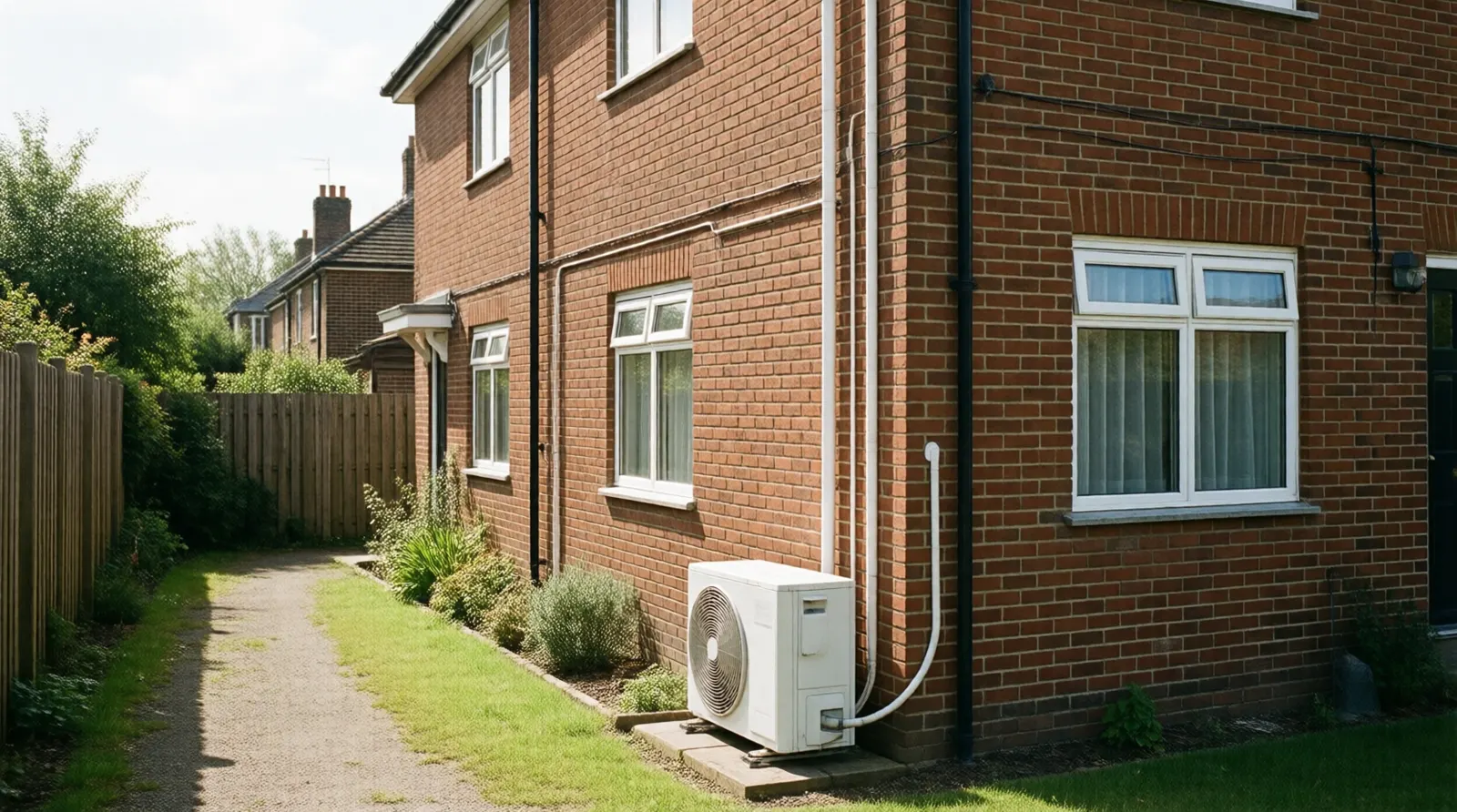
A garage conversion needs heating and cooling, and a single wall-mounted split system does both without plumbing anything back to the boiler. Expect £1,800 to £2,800 fitted for one room, including VAT.
That matters more in late October than in July. The gym, office or playroom that cost £8,000 to convert is now the one room nobody sits in, because the radiator never arrived or never worked.
Why the converted garage runs cold
The room starts at a disadvantage on four counts.
The flank wall is often single skin, one brick thick with no cavity. The floor is a ground-bearing slab poured for a car, with no insulation under it. The old up-and-over door has been infilled, sometimes in thin blockwork with a window dropped in. And the roof is flat or shallow pitched, with whatever insulation fitted at the time.
Building Regulations treat a garage becoming a habitable room as a change of use, so Part L asks for insulation to a set standard, with external walls around 0.3 W/m²K. Plenty of conversions from before 2013, and most of the ones done without a building notice, never got near that. Check what is behind the plasterboard before you price any heating. A unit fitted to a bare shell runs flat out and still loses.
Heating it without touching the boiler
The usual plan is a radiator on an extension of the existing circuit. A plumber quotes £400 to £900 to run flow and return across the house, more where floors have to come up, and the far end of an older system often sits lukewarm once another radiator joins it.
A split system in heating mode avoids all of that. It delivers around three units of heat for every unit of electricity, so 2kW of warmth costs roughly 16p an hour at the 24p per kWh cap, against 48p for the oil-filled radiator most converted garages end up with. We set out the full comparison in heating with air conditioning.
It cools in summer as well, which the radiator never will. A converted garage with a west-facing infill wall gets warm by late afternoon, and a gym gets warm whatever the wall faces. Cooling costs 18p to 24p an hour for a room this size, broken down by room in our cost per hour guide.
Size it for the fabric, not the floor plan
The rough rule is 1kW of cooling per 8 to 10 square metres. A single garage runs about 2.6m by 5.5m internally, so 15 square metres, which points at 2.5kW.
Push up from there where the build is poor. Single-skin walls, an uninsulated slab and a thin infill panel all pull heat out in winter and let it in during summer. All-day use as an office or a gym adds to the load again. Most converted single garages land on 3.5kW, and a double garage split into two rooms needs a unit in each or a two-head multi-split.
Ask for the heating output at 2C and at -7C rather than the nominal figure on the box. A unit rated at 3.5kW may give 2.6kW on a frosty January morning, which is the morning you care about. Our sizing guide covers the calculation a good installer runs.
The circuit is usually the sticking point
Garages tend to be fed by one radial from the house consumer unit, sometimes through a small garage board, on a 16A or 20A breaker. That circuit is already carrying lights, sockets, a chest freezer and whatever the conversion added.
An installer wants a dedicated circuit for the unit and an isolator beside the outdoor condenser. Budget £120 to £250 where the board has a spare way and RCD protection. Older boards need replacing first, which our guide to air con and your electrics explains.
Where the condenser can and cannot go
This is the point that catches garage conversions specifically. Permitted development asks that the outdoor unit is not fitted to a wall facing a highway, and an attached garage normally sits at the front or the side of the house. The obvious wall is the one you cannot use.
So the condenser goes on the flank wall out of sight of the road, on the rear wall, or on a ground pad beside the house. Each option lengthens the pipe run, and a longer run costs more and takes longer to fit. Keep a metre from the boundary, and point the fan away from the neighbour’s windows. Our planning guide has the full conditions, including conservation areas and Article 4 directions.
One practical warning. Do not let anyone bracket a condenser onto the infill panel where the garage door used to be. It is often a single leaf of blockwork tied into the original opening, not structural masonry. Mount onto the original wall or stand the unit on a pad.
What it costs
One wall unit in a converted garage sits in the single-room bracket on our prices page: £1,800 to £2,800 fitted, including VAT. Expect the middle to upper end, because the pipe run has to come round to a wall away from the road and the circuit usually needs adding.
A double garage split into two rooms falls into the two-room multi-split bracket at £3,500 to £5,500, sharing one outdoor unit.
Book the survey while the diary is quiet
October to February is the quiet half of the installer year. A survey now gets a proper measure-up and a fitting date in weeks rather than the months a June enquiry waits.
Tell us on the quote form what the garage was converted into, roughly how big it is, and whether you know what insulation went in. Up to three vetted North West installers survey and come back with a fixed price within 24 hours.
Check the prices page for a bracket first, or email us if you want a second opinion on a heating quote you already have.
Common questions
Can you put air conditioning in a garage conversion?+
Yes. A single wall-mounted split system suits a converted garage well, because it heats and cools without any wet pipework from the boiler. A single split costs £1,800 to £2,800 fitted including VAT, and a converted single garage usually needs a 2.5kW to 3.5kW unit.
Is air conditioning cheaper than adding a radiator to a garage conversion?+
The install often costs more and the running costs are lower. A plumber extending the heating circuit across the house quotes £400 to £900, but a split delivers around three units of heat per unit of electricity, so 2kW of warmth costs roughly 16p an hour against 48p for an oil-filled radiator at 24p per kWh.
Where does the outdoor unit go on a garage conversion?+
Not on a wall facing the road. Permitted development asks that the unit is not fitted to a wall facing a highway, and most garages sit at the front or side of the house. The condenser normally goes on the flank or rear wall, or on a ground pad beside it, which lengthens the pipe run.
What size air conditioning unit does a converted garage need?+
Start at 1kW of cooling per 8 to 10 square metres, then allow for the build. A 15 square metre conversion would take 2.5kW in a normal room, but single-skin walls, an uninsulated slab and all-day use push it to 3.5kW.
Does a garage conversion need insulating before air conditioning goes in?+
Insulate first wherever you can. Building Regulations ask for insulation when a garage becomes a habitable room, and a conversion done without it loses heat faster than any unit can replace. Air conditioning in a cold, bare shell runs flat out and costs more every hour.
Ready for a real quote?
Get up to 3 fixed prices from vetted North West installers.
Air conditioning quotes near you
Local price guides and installer coverage across the North West.
More on Guides
Can you take air conditioning with you when you move house?
A fitted split system counts as a fixture, so it stays with the house unless you exclude it in writing before contracts. Here is what a strip-out and refit really costs against a fresh install, why the warranty does not travel, why the old pipework rarely fits the next house, and what to check if you are buying a home that already has air con.
Does air conditioning affect your home insurance?
A fitted split system rarely moves your premium, but it does belong on your insurer's record. Here is why a wall-mounted condenser is usually covered as part of the building while a ground-mounted one may not be, what the property in the open limit means, which paperwork settles a claim, and how much an install adds to your rebuild figure.
Can you buy your own air conditioning unit and pay someone to fit it?
Some installers will fit a unit you supplied. Most refuse, and the ones who agree charge a labour-only rate that leaves you £200 to £500 ahead on a job that costs £1,800 to £2,800 fitted. Here is why installers say no, what the November sale listings hide, and the one case where supply-only genuinely works.