
Air conditioning in a new build: why Part O homes still overheat
A new build holds heat better than the house you left, and the 2022 overheating rules did not put cooling in it. Here is what Part O actually requires, which rooms complain first, how a timber frame wall changes the install, and the warranty and covenant checks to make before you book.
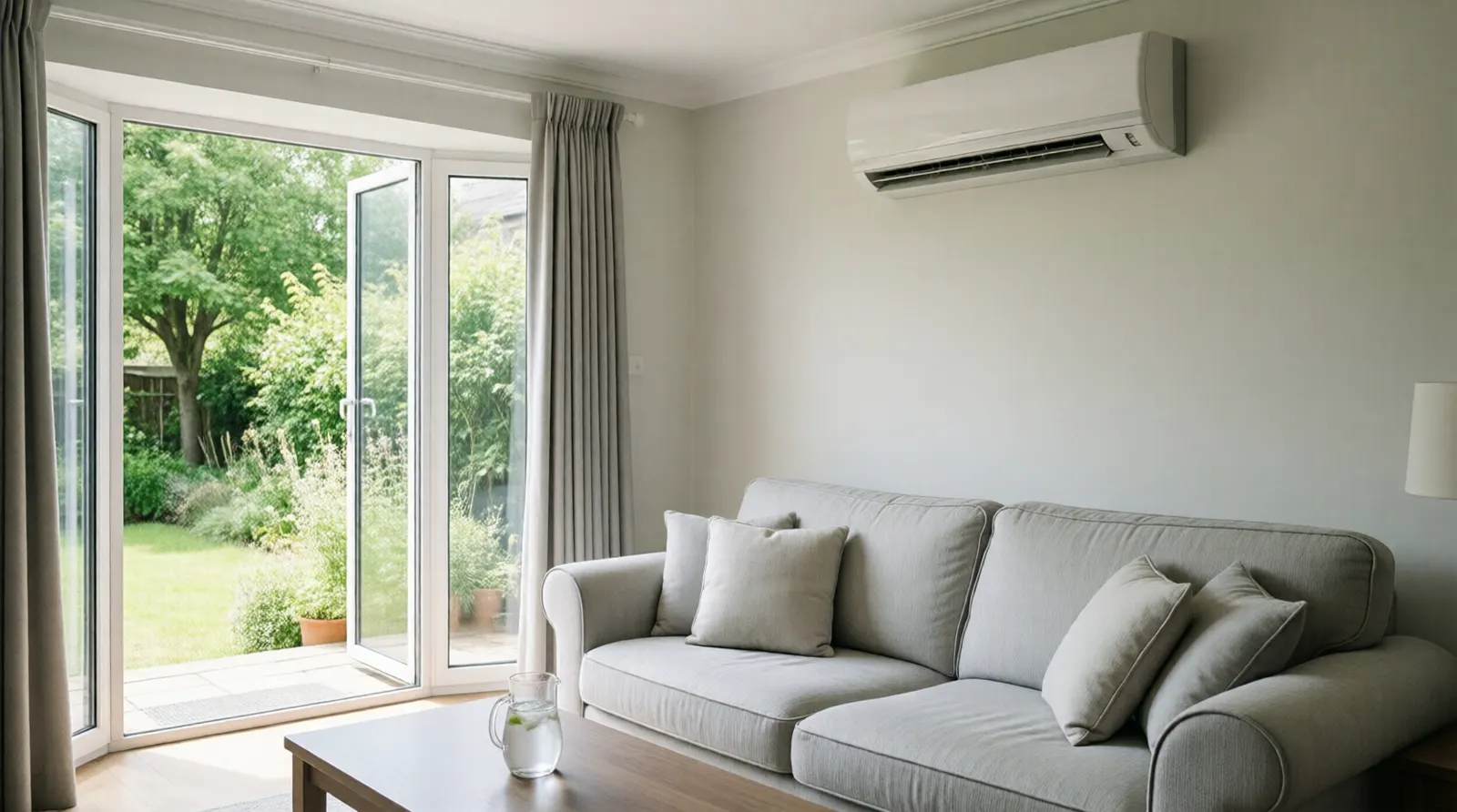
A new build holds summer heat better than the house you moved out of, and the 2022 overheating rules did not put cooling in it. Part O limits the glass and asks for a way to shift heat, then stops short of requiring a cooling system, so a compliant home can still sit at 26C in a bedroom at midnight. Retrofitting is simple enough: £1,800 to £2,800 for one room, with the checks in the paperwork rather than the brickwork.
Why the new house runs hotter than the old one
An old house leaks. Draughts round the sashes, an open chimney and a cold loft hatch dump heat overnight, which is why a Victorian terrace cools down by morning.
A new build does the opposite, by design. Airtightness near 3 cubic metres per hour per square metre, 150mm of insulation and good glazing keep heat where it is. That works beautifully in February. In July, the sun comes through the glass, the fabric soaks it up, and nothing takes it back out. Once the walls and screed are warm, they radiate until the early hours. Our guide on whether air conditioning adds value notes the same pattern in heavily insulated homes.
What Part O actually requires
Approved Document O took effect on 15 June 2022 and covers new dwellings in England, houses and flats. Homes with plans submitted earlier and started on site before June 2023 had transitional cover, so they may predate it.
It asks for two things: limit unwanted solar gain, and provide a means of removing excess heat. The simplified method caps glazing as a percentage of floor area by orientation, then checks the openable area of the windows. The other route uses thermal modelling to CIBSE TM59.
The rules split England into high risk locations, which are urban and some suburban parts of London, and moderate risk, which is everywhere else. The North West sits in the moderate band, though industry guidance flags parts of central Manchester for raised night-time temperatures.
The means of removing heat is normally an openable window. Upper-floor windows carry safety restrictors, estates near a main road get acoustic glazing that stays shut, and mechanical cooling sits at the bottom of the hierarchy as a last resort. Compliance on paper and a comfortable bedroom are two different things.
Part O does not govern what you fit afterwards. That is a planning and consent question.
The rooms that complain first
- The top bedroom of a three-storey townhouse. Warm air stacks up the stairwell and the room sits under the roof. These are the plots that ring in August.
- A south or west facing main bedroom with a full-height window. Compliant glazing area, hot room.
- The open plan kitchen diner with bifolds and a rooflight. Cooking load, solar gain and no door to close. Our guide to air conditioning in a kitchen extension covers the sizing maths.
MVHR ventilates, it does not cool
Most new builds have mechanical ventilation with heat recovery. It is good at air quality and bad at heat.
Summer bypass stops the system handing incoming air the warmth of the outgoing air. That helps at 6am and does nothing at 4pm, when the air outside is hotter than the air inside. You cannot push cooled air down MVHR ducts either, because they are sized for ventilation rates rather than a cooling load. A split system is a separate circuit that runs alongside them.
Timber frame changes the hole in the wall
Plenty of new builds in the North West are timber frame with a brick skin, which changes the detail of a 65mm pipe penetration. The wall is brick, a cavity, a breather membrane, sheathing board, then studs at 600mm centres. The core drill has to miss the studs and noggins, and the sleeve has to be sealed back to the membrane so the drainage plane stays intact. Ask any installer quoting on a timber frame plot how they will seal it, and get the answer in writing.
The rest is easy. Pipe runs are short, the outdoor unit goes on the rear elevation, and consumer units normally have spare ways, so the dedicated circuit is cheap. Our guide on electrics for air conditioning sets out what that circuit needs.
Warranty, covenants and the estate
Three checks before you book, all of them paperwork.
- The ten-year warranty. A new penetration through the external envelope counts as an alteration. Tell the developer and the warranty provider in writing, keep the F-Gas certificate, and wait until snagging on that wall is done.
- Restrictive covenants. Transfer deeds on new estates often require management company or developer consent for external alterations, and a condenser is one. Read the deed.
- Planning conditions. Permitted development usually covers a condenser sited a metre from the boundary and off any elevation facing a highway, but some estates have those rights removed. Our planning permission guide lists every condition.
Sizing and 2026 prices
A well insulated new build loses little heat through the walls, so the cooling load comes from the glass and the people. Check the room with our BTU calculator rather than a floor-area rule of thumb. A 12 square metre bedroom with a west-facing full-height window lands near 1.8kW, which is a 2.0kW head, not the 1.5kW the floor area suggests.
One wall unit sits in the single-room bracket on our prices page: £1,800 to £2,800 fitted, including VAT. New builds land in the lower half, because the wall drills cleanly and the runs are short. Two heads on one outdoor unit come to £3,500 to £5,500, and three rooms to £5,500 to £8,500.
If the house is not built yet, ask the developer about first fix. Pipework and drains run in before the plasterboard for a fraction of the retrofit cost, and ducted systems at £12,000 to £25,000 only make sense at that stage.
Book it over the winter
October to February is the quiet half of the installer year, and a timber frame plot with a covenant to read wants a proper survey, not a July squeeze. Our guide on the best time to install air conditioning explains how demand moves.
Tell us on the quote form which rooms overheated this summer, the plot’s construction if you know it, and whether the estate has a management company. Up to three vetted North West installers survey and come back with a fixed price within 24 hours.
Check the prices page for a bracket first, or email us if you want the warranty and covenant angle checked before you book.
Common questions
Can you fit air conditioning in a new build house?+
Yes. A new build is one of the easier retrofits because the walls core drill cleanly, the pipe runs are short and the consumer unit usually has a spare way. The checks are paperwork rather than building work: the developer warranty, any restrictive covenant in the transfer deed, and whether planning conditions on the estate removed permitted development rights.
Does Part O mean my new build cannot overheat?+
No. Part O limits summer solar gain and asks for a way to remove heat. It does not require cooling, and it treats mechanical cooling as the last step after shading and ventilation. A home can satisfy Part O and still sit at 26C in a bedroom at midnight.
Will fitting air conditioning void my NHBC warranty?+
Not by itself, but a new hole through the external wall is an alteration. Tell the developer and the warranty provider in writing before the install, keep the F-Gas certificate and the installer's detail of how the sleeve was sealed, and book the work after any snagging that involves the same wall.
Can air conditioning run through the MVHR ducts?+
No. A standard MVHR system moves ventilation air, not cooled air, and its ducts are not sized for a cooling load. Summer bypass only helps when the outside air is cooler than the inside air, which is not the case at 4pm in July.
How much does air conditioning cost in a new build?+
£1,800 to £2,800 fitted for one room, including VAT, and new builds tend to land in the lower half of that bracket. Two rooms sharing one outdoor unit come to £3,500 to £5,500 and three rooms to £5,500 to £8,500.
Ready for a real quote?
Get up to 3 fixed prices from vetted North West installers.
Air conditioning quotes near you
Local price guides and installer coverage across the North West.
More on Guides
Can you take air conditioning with you when you move house?
A fitted split system counts as a fixture, so it stays with the house unless you exclude it in writing before contracts. Here is what a strip-out and refit really costs against a fresh install, why the warranty does not travel, why the old pipework rarely fits the next house, and what to check if you are buying a home that already has air con.
Does air conditioning affect your home insurance?
A fitted split system rarely moves your premium, but it does belong on your insurer's record. Here is why a wall-mounted condenser is usually covered as part of the building while a ground-mounted one may not be, what the property in the open limit means, which paperwork settles a claim, and how much an install adds to your rebuild figure.
Can you buy your own air conditioning unit and pay someone to fit it?
Some installers will fit a unit you supplied. Most refuse, and the ones who agree charge a labour-only rate that leaves you £200 to £500 ahead on a job that costs £1,800 to £2,800 fitted. Here is why installers say no, what the November sale listings hide, and the one case where supply-only genuinely works.