
Air conditioning for a kitchen extension: rooflights, bifolds and open plan heat
Kitchen extensions overheat because of the glass and the cooking. Here is how to size a unit for one, where the indoor unit should go, why fitting it during the build costs less, and what it comes to in 2026.
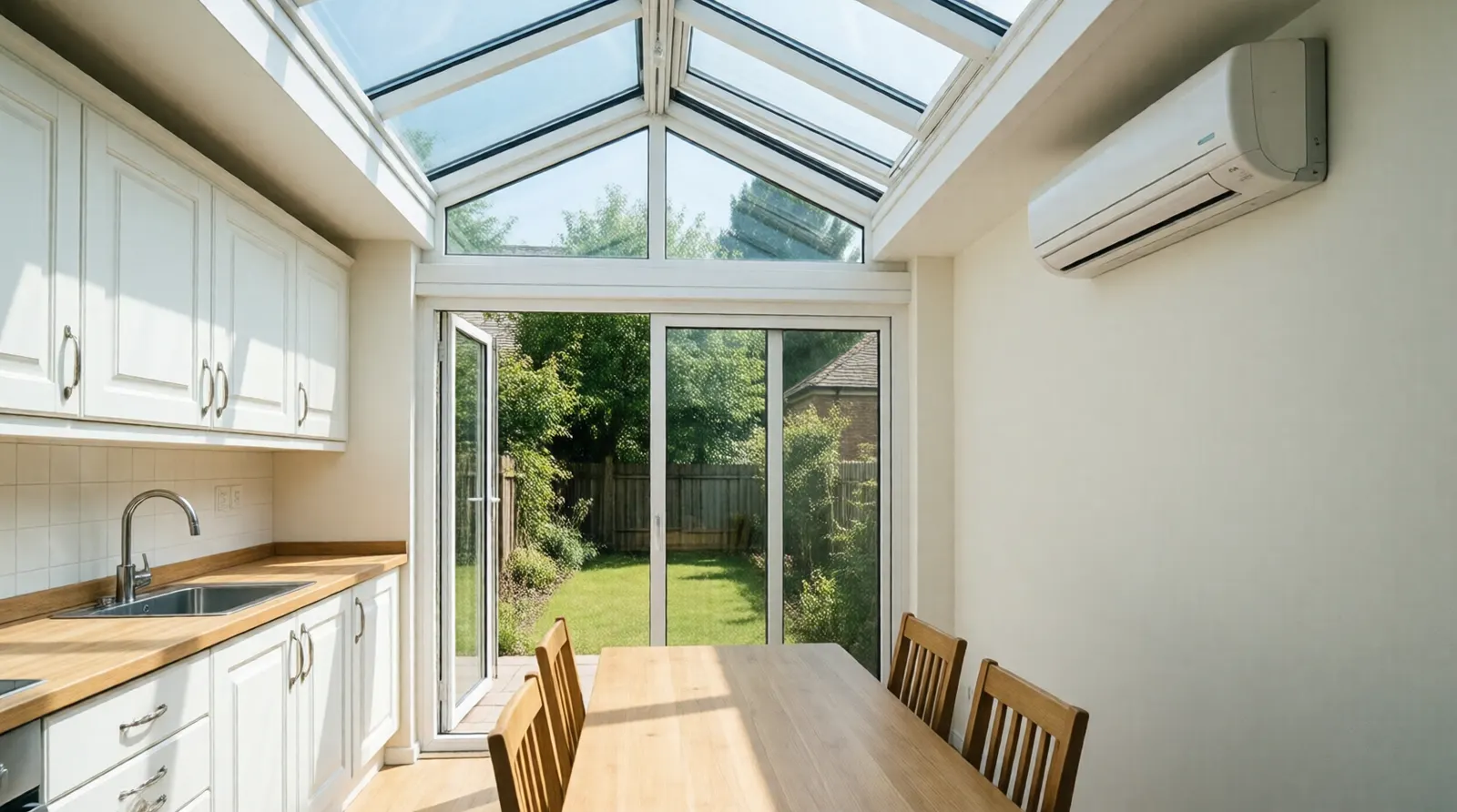
A kitchen extension needs more cooling than its floor area suggests. Most single-storey extensions of 20 to 30 square metres want 3.5kW to 5kW, at £1,800 to £2,800 fitted for one wall-mounted split, and the cheapest moment to do the work is during the build rather than two summers later. Here is why these rooms run hot, how to size for one, and what to settle before the plasterer arrives.
Why extensions are the hottest room in a new layout
Four heat sources stack up in the same space, and they peak at different times of day.
Rooflights come first. Glass set near horizontal takes far more solar gain through the middle of the day than a vertical window of the same size, because the sun hits it square on. Two rooflights at 1m by 1.5m give you 3 square metres of glass pointed at the sky.
Bifolds and sliders come second. They face the garden, which in most UK houses means south or west, so they take the full afternoon sun. A 4m bifold is roughly 7 square metres of glazing.
Cooking comes third, and people forget it. An oven draws 2kW to 3kW, a hob more, and all of that heat ends up in the room. Nobody cooks in a bedroom, which is why a bedroom sizing rule falls apart here.
Open plan is the fourth. There is no door to shut. The room is joined to the hall, the stairs and often the old kitchen, so warm air arrives from the rest of the house and cooled air drifts away.
Sizing: start from the glass, not the floor
Our BTU sizing guide gives the base calculation. A kitchen extension needs the glazing and the cooking added on top of it.
A worked example. A 5m by 4m extension is 20 square metres. On bedroom rules that is a 2.5kW unit. Add 3 square metres of rooflight, a 4m bifold and an oven, and the real load lands at 3.5kW, often 5kW if the glazing faces west and there is no shading at all.
The test of a surveyor is whether they ask about the glass. If a quote arrives after a phone call about room dimensions, get a second one. The same mistake shows up in glass rooms generally, which our guide to air conditioning for a conservatory covers in more detail.
Where the indoor unit goes
Open plan rooms give you fewer good positions than they appear to.
A solid gable or side wall, high up, blowing down the long axis of the room, is the position to aim for. Cold air then mixes on the way down and reaches the far end.
Three spots to avoid. Directly above the hob, where cooking grease loads the filters. Directly over the dining table, where people sit in the draught for an hour at a time. And above bifold doors, where the head clearance is wrong and the pipe route has to climb around the frame.
Where the extension has a flat roof with a service void, a ceiling cassette flush in the plasterboard is neat and keeps the walls clear. It costs £2,500 upward because of the ceiling work, and it only works if the void depth is agreed with the builder early.
The condenser sits outside on the flank wall or on a ground pad at the side of the extension. Keep it off the wall of a neighbouring bedroom and give it clear air on all sides.
Fit it during the build
This is the part worth acting on if the extension is still on site.
Before plastering, an installer can chase the copper pipework, the condensate drain and the control cable into the blockwork. Nothing is visible afterwards except the unit itself. The condensate can run into the new waste rather than dribbling onto the patio, and the power spur can come off the new circuit while the electrician is already there.
Doing it this way saves roughly £300 to £600 in labour against a retrofit, and it removes the white trunking a later install leaves down the outside wall.
Autumn is the right time to book this. Installer diaries are clear from late September to February, so a first fix fits around a build programme without a six-week wait. Our guide on the best time to install air conditioning has the seasonal detail.
What it costs in 2026
One wall-mounted split in a kitchen extension sits in the single-room bracket on our prices page: £1,800 to £2,800 fitted. Expect the upper half of it. Extensions sit at the back of the house, so pipe runs to a condenser position with decent access tend to be longer than a front-bedroom job.
Two heads, one in the extension and one in the adjoining lounge or snug, share a single outdoor unit and land at £3,500 to £5,500. Three rooms across the ground floor run £5,500 to £8,500. A ducted system with grilles only starts around £12,000 for a whole house, so for a single extension a wall unit or a cassette is the sensible route.
First-fix pipework during the build is usually quoted separately at a few hundred pounds, then the rest on completion.
Planning and the neighbours
The indoor work needs no permission. The outdoor unit is covered by permitted development in most cases, with the conditions that catch people out being the distance from the boundary and the noise limit measured at the neighbouring property. Conservation areas and listed buildings have their own rules. Our guide to planning permission for air conditioning sets out the tests.
The winter half
Kitchen extensions are cold in January for the same reason they are hot in July. All that glass loses heat, and underfloor heating under a solid floor takes hours to respond on a cold morning.
The same unit heats, and it reaches temperature in minutes rather than hours. Running an extension on air conditioning in heat mode through the shoulder months is cheaper than turning the whole house boiler on for one room.
Get your extension priced properly
Tell us on the quote form the extension size, how many rooflights it has, the width of the bifolds and which way they face. Say if the build is still on site, because that changes the job. Up to three vetted North West installers survey and come back with a fixed price within 24 hours.
Check the prices page for a bracket first, or email us if you want to talk through first-fix timing with your builder’s programme.
Common questions
What size air conditioning unit does a kitchen extension need?+
Most single-storey kitchen extensions of 20 to 30 square metres need 3.5kW to 5kW. Rooflights and cooking appliances push the load well above what the floor area alone suggests, so a 20 square metre extension often needs the unit you would fit in a 30 square metre bedroom.
How much does air conditioning for a kitchen extension cost?+
£1,800 to £2,800 fitted for one wall-mounted split, towards the upper half of that bracket once you allow for a longer pipe run around a new build. Adding a second head for an adjoining snug or lounge puts you in the two-room bracket of £3,500 to £5,500.
Is it cheaper to fit air conditioning during the extension build?+
Yes. First-fix pipework, the condensate drain and the power supply go in before plastering, which saves roughly £300 to £600 in labour and leaves no trunking on show. Ask your builder to leave the unit position and the pipe route clear before the plasterer arrives.
Where should the indoor unit go in an open plan kitchen diner?+
High on a solid wall, blowing down the long axis of the room, away from the hob and away from the dining table. A gable or side wall usually works. Above bifold doors is the worst spot, because the head clearance is wrong and the pipe route is awkward.
Ready for a real quote?
Get up to 3 fixed prices from vetted North West installers.
Air conditioning quotes near you
Local price guides and installer coverage across the North West.
More on Guides
Can you take air conditioning with you when you move house?
A fitted split system counts as a fixture, so it stays with the house unless you exclude it in writing before contracts. Here is what a strip-out and refit really costs against a fresh install, why the warranty does not travel, why the old pipework rarely fits the next house, and what to check if you are buying a home that already has air con.
Does air conditioning affect your home insurance?
A fitted split system rarely moves your premium, but it does belong on your insurer's record. Here is why a wall-mounted condenser is usually covered as part of the building while a ground-mounted one may not be, what the property in the open limit means, which paperwork settles a claim, and how much an install adds to your rebuild figure.
Can you buy your own air conditioning unit and pay someone to fit it?
Some installers will fit a unit you supplied. Most refuse, and the ones who agree charge a labour-only rate that leaves you £200 to £500 ahead on a job that costs £1,800 to £2,800 fitted. Here is why installers say no, what the November sale listings hide, and the one case where supply-only genuinely works.