
Air conditioning for a nursery: keeping a baby's room at a safe temperature
UK guidance puts a baby's room at 16C to 20C. Here is why nurseries overheat, whether air conditioning is safe for an infant, how to position and size it, and what it costs in 2026.
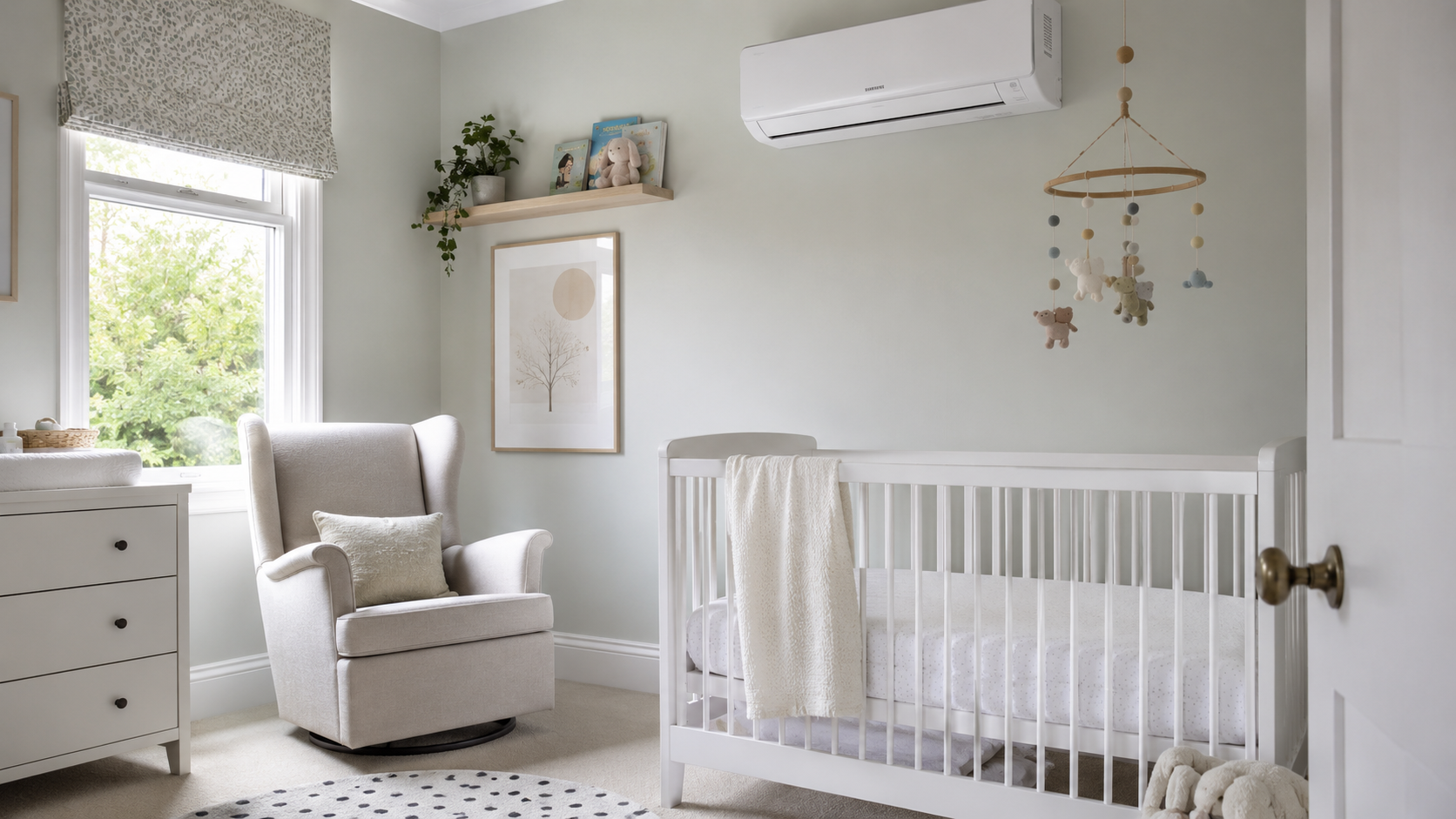
A nursery is the one room in the house where temperature stops being about comfort. UK safe sleep guidance puts a baby’s room between 16C and 20C. On a July night in a small upstairs bedroom, that figure can look like fiction. Plenty of parents spend the summer with a fan aimed at a wall, a room thermometer stuck on 26C, and a baby who will not settle.
The number you are trying to hit
The Lullaby Trust and the NHS both point to 16C to 20C for a room a baby sleeps in, with 18C treated as the middle of the range. Overheating is a recognised risk factor in sudden infant death, which is why that range gets handled as a rule rather than a preference.
A typical UK box bedroom after a hot day sits at 24C to 28C by ten in the evening, and it stays there. Brick, plaster and a warm loft above release stored heat back into the room all night. Opening the window pulls in air that is often still above 20C during a heatwave, along with road noise and anything else going on outside.
That gap between 26C and 18C is not one a fan can close. A fan moves air across skin without lowering the room temperature, and infant guidance discourages pointing one directly at a baby, so even that limited trick is off the table.
Why nurseries run hotter than the rest of the house
Nurseries are usually the smallest bedroom, with one window on one wall and no cross breeze. Small rooms heat up fast because there is little air volume to absorb the gain.
The door stays shut for sleep, so the room is sealed for twelve hours at a stretch. A blackout blind keeps light out during long summer evenings, and it traps warm air between the blind and the glass at the same time.
Then there is the low-level electrical load. A monitor, a night light, a plug-in warmer and a humidifier each add a little heat, and they all run through the night in a room that cannot shed it.
Is air conditioning safe in a baby’s room?
Yes, provided three things are right. This is the question parents ask first, and the honest answer is that positioning matters more than the equipment.
Airflow direction. The unit should never blow across the cot. Mount the indoor head so the air throw crosses the room above cot height, ideally on the wall behind or beside the cot rather than facing it. Agree the exact position with the surveyor on the day, with the cot where it will actually stand.
Set point rather than blast. Set the unit to 19C or 20C and let it hold there. A modern inverter unit modulates its output to maintain a temperature instead of cycling hard on and off, which is what produces cold draughts and noise. Chasing 16C makes the room feel harsh and dries the air out.
Air moisture. Cooling removes humidity as a side effect. Running at 20C rather than the coldest setting keeps that mild. If your nursery already runs dry in winter, mention it at survey and keep an eye on it in the first week.
Filters need a wipe every so often, in the same way any appliance in a child’s room does. Ask the installer to show you how the front panel opens before they leave.
Noise decides the unit more than anything else
In a nursery, quiet is not a luxury feature. A wall-mounted split running on its lowest fan speed sits around 19 to 22 dB on the better bedroom models, which is quieter than a fridge in the next room and quieter than most baby monitors.
A portable unit is the wrong tool here. The compressor sits inside the room, running at 50 to 65 dB, with a hose out of a window that has to stay open. It will wake the baby it is meant to help. Our guide to the quietest air conditioners for bedrooms covers which models hold up at low speed.
Sizing a small room without overdoing it
Most nurseries need 2.0kW to 2.5kW. The temptation is to go bigger for a hot summer, and that backfires in a small room. An oversized unit drops the temperature quickly, shuts down, lets the room drift back up, then starts again. Those swings and the noise of a compressor stopping and starting are worse for sleep than a slightly slower cool-down.
Ask the installer to size on the heat load, taking in the window direction, whether the room is under the loft, and the fact that the door stays closed. Our BTU sizing guide explains the calculation.
What it costs in 2026
A nursery is a single-room install and often one of the cheaper rooms in the house to fit, because the unit is small and upstairs bedrooms usually sit close to a good condenser position.
Expect £1,800 to £2,300 fitted for a properly sized wall unit in a standard nursery, at the lower end of the single-room bracket on our prices page. A long pipe run around the house, a condenser that has to go on a bracket, or a concealed internal route will add to that.
Doing the nursery and the main bedroom together as a two-room multi-split lands at £3,500 to £5,500, with both heads sharing one outdoor unit. If both rooms struggle in summer, that is better value than two separate jobs a year apart.
The winter half of it
Small bedrooms at the end of a heating run are often the coldest room in the house from November. A heat-pump unit heats as well as cools, holding 18C steadily rather than the swing you get from a radiator on a timer. It is a safer source of heat in a child’s room than a plug-in electric heater with a hot surface, and it costs a good deal less to run.
Get a nursery priced properly
Say it is a nursery in the notes on the quote form, and mention the room size, which way the window faces, and where the cot sits. We match you with installers who will position the unit around the cot rather than the other way round. Three fixed quotes back within 24 hours from vetted North West installers.
Or check the prices page for a rough bracket first, or email us a question if you want to talk it through before requesting quotes.
Ready for a real quote?
Get up to 3 fixed prices from vetted North West installers.
More on Guides
Air conditioning in a flat: what leaseholders need to know
Flats overheat worse than houses and carry the tightest rules on fitting cooling. Here is what your lease says, where the condenser can go, what freeholder consent costs, and the options when there is no outdoor space at all.
What temperature should you set your air conditioning?
Setting 16C does not cool a room any faster, and it costs you for the privilege. Here is the setpoint that works in a UK summer, what each degree adds to the bill, and when dry mode beats cool mode.
Air conditioning for pets: keeping dogs, cats and rabbits cool in a UK summer
Fans do far less for a panting dog than they do for you. Here is what heat does to UK pets indoors, which room to cool, what it costs to run while you are out, and when a fitted unit is worth it.