
Can a business claim air conditioning against tax?
Air conditioning counts as an integral feature, so it sits in the special rate pool at 6 percent a year. The Annual Investment Allowance turns that into 100 percent relief in year one. Here is how the claim works and what a real install costs after tax.
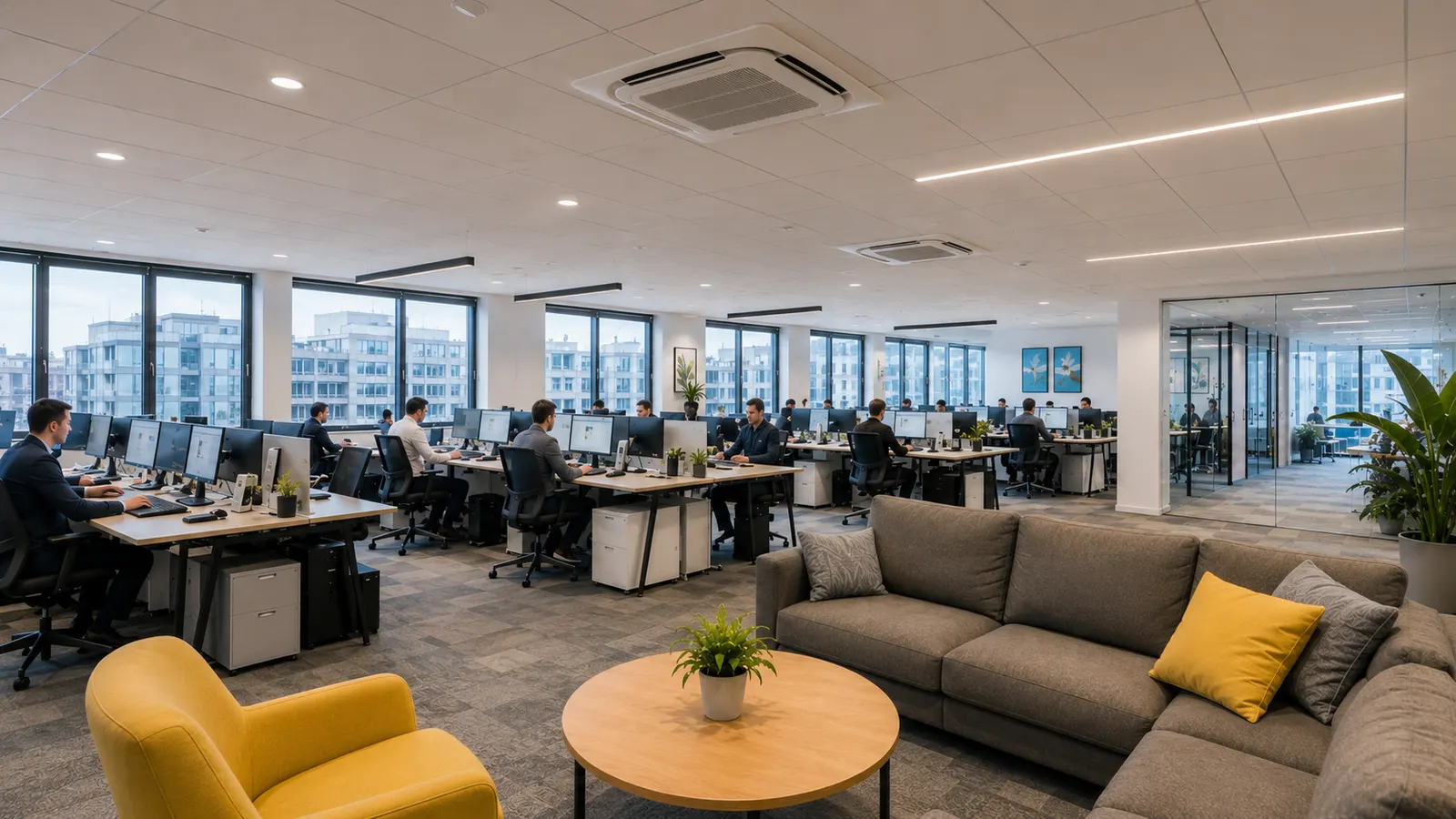
Autumn is when accountants start asking about year end spending. If cooling is on the list for next summer, the tax treatment changes the real cost by a quarter or more.
Air conditioning is not a simple business expense you deduct in full on the profit and loss. It has its own category in the capital allowances rules, and that category has a trap in it. Here is how the claim actually works.
Air conditioning is an integral feature
The Capital Allowances Act names powered systems of ventilation, air cooling and air purification as integral features of a building. Space heating systems sit in the same list, which covers a reversible split running in heating mode.
Integral features go into the special rate pool. That pool writes down at 6 percent a year on a reducing balance. Left on its own, a £4,000 install gives you £240 of relief in year one, £226 in year two, and a long tail after that. At 25 percent corporation tax, year one is worth £60.
That is the trap. Buy the kit, claim it the slow way, and the benefit arrives over two decades.
The Annual Investment Allowance fixes it
The Annual Investment Allowance gives 100 percent relief in the year of purchase, up to £1,000,000 a year. It covers special rate expenditure, which means it covers air conditioning.
For almost every small business this is the only route worth using. A £4,000 install claimed under the allowance comes off taxable profit in full, in the year the work is done.
What that saves depends on how you trade.
- Company paying the small profits rate of 19 percent: £760 off the tax bill. Net cost £3,240.
- Company paying the main rate of 25 percent: £1,000 off. Net cost £3,000.
- Sole trader or partner taxed at 40 percent: £1,600 off income tax, plus 2 percent Class 4 National Insurance on profits above the upper limit.
The £1,000,000 limit is per year and shared across a group of companies. No small shop, salon or office is going near it on a cooling install.
The full expensing trap
Companies have had 100 percent full expensing on plant and machinery since April 2023, and the headlines made it sound universal. It is not.
Full expensing applies to main rate plant. Special rate expenditure gets a 50 percent first year allowance instead, with the balance dropping into the pool at 6 percent.
So a company that claims air conditioning under full expensing rules gets half of what the Annual Investment Allowance would have given it. If your accountant reaches for full expensing by reflex on a £4,000 install, that is £2,000 of relief instead of £4,000. Point them at the allowance.
What it costs after tax, on real brackets
Our prices page puts a small office or retail unit at £2,500 to £4,500 fitted, and a restaurant, salon or medium retail install at £5,000 to £12,000. Run those through the allowance at the 25 percent corporation tax rate.
- Small office or shop, £2,500 to £4,500 fitted. Relief of £625 to £1,125. Net cost £1,875 to £3,375.
- Salon or medium retail, £5,000 to £12,000 fitted. Relief of £1,250 to £3,000. Net cost £3,750 to £9,000.
- Server room cooling, £4,000 to £15,000 fitted. Relief of £1,000 to £3,750. Net cost £3,000 to £11,250.
Set that against the winter heating saving and the payback shortens again. We ran those numbers in shop and salon cooling.
VAT is a separate question
Capital allowances reduce your taxable profit. VAT is nothing to do with them.
If your business is VAT registered and the installer is VAT registered, the VAT on the invoice is normally recoverable as input tax in the quarter the invoice falls. The figures above then work on the net price, not the gross. A business below the registration threshold pays the VAT and claims the whole gross figure through capital allowances instead.
Cooler Spaces is not VAT registered and charges you nothing either way. The installer invoices you directly.
Timing decides which year it lands in
Expenditure counts when it is incurred, not when you pay. For most installs that is the date the work completes and the obligation to pay becomes unconditional, which is usually the invoice date.
An install finished a week before your year end falls into that year. One finished a week after waits twelve months for the relief. If your year end is 31 December or 31 March, autumn booking puts the job on the right side of the line, and commercial lead times are shorter now than they will be in spring. We set out the seasonal timing in when to plan commercial air conditioning.
Leased premises
A tenant who pays for the install owns the expenditure and makes the claim, even though the kit is fixed to someone else’s building. The lease still decides whether the work can happen at all, and a reinstatement clause can mean stripping it out at the end of the term. We covered the alterations clause and the licence to alter in fitting air conditioning in a leased commercial unit.
If the landlord pays and recharges you through the service charge, the claim is theirs, not yours. Check which of those two is happening before you budget for the relief.
Two things that no longer exist
Enhanced Capital Allowances for energy saving plant closed in April 2020. The Energy Technology List went with it. Any supplier still quoting either as a reason to buy is working from an old script.
None of this is tax advice. The rules turn on your accounting period, your profit level and your trading structure, so put the quote in front of your accountant before you commit.
Get quotes your accountant can work from
Tell us the floor area, the type of premises and your year end date on the quote form. We will match you with commercial installers who cover your postcode, and you get three fixed written quotes back within 24 hours, dated and itemised for the claim.
Check the prices page for a rough bracket first, or email us a question if you want to talk it through before requesting quotes.
Ready for a real quote?
Get up to 3 fixed prices from vetted North West installers.
Air conditioning quotes near you
Local price guides and installer coverage across the North West.
More on Commercial
Air conditioning for a pharmacy or dispensary
Most medicines are labelled to be stored below 25C, and the dispensary is the room that breaks that line first. Here is which rooms to cool and in what order, why cooling does nothing for ventilation in a consultation room, what room temperature does to a pharmacy fridge, and 2026 fitted prices.
Air conditioning for a holiday let or Airbnb
Air conditioning in a holiday let protects your summer reviews and sells winter nights the cottage used to lose. One bedroom runs £1,800 to £2,800 fitted and a bedroom plus living space £3,500 to £5,500. Here is which rooms to cool first, why the April 2025 tax change matters, how to stop guests running it with the windows open, and the condenser rules in a village or a block.
Air conditioning for a dental practice or clinic
A split system cools a surgery, a waiting room and a decontamination room, and heats them in winter for a third of the cost of electric panels. It does not supply fresh air, so it never counts towards the air changes an aerosol generating procedure needs. Here is what to cool, where to put the indoor unit, noise limits for a treatment room, and 2026 fitted prices.