
Air conditioning for a holiday let or Airbnb
Air conditioning in a holiday let protects your summer reviews and sells winter nights the cottage used to lose. One bedroom runs £1,800 to £2,800 fitted and a bedroom plus living space £3,500 to £5,500. Here is which rooms to cool first, why the April 2025 tax change matters, how to stop guests running it with the windows open, and the condenser rules in a village or a block.
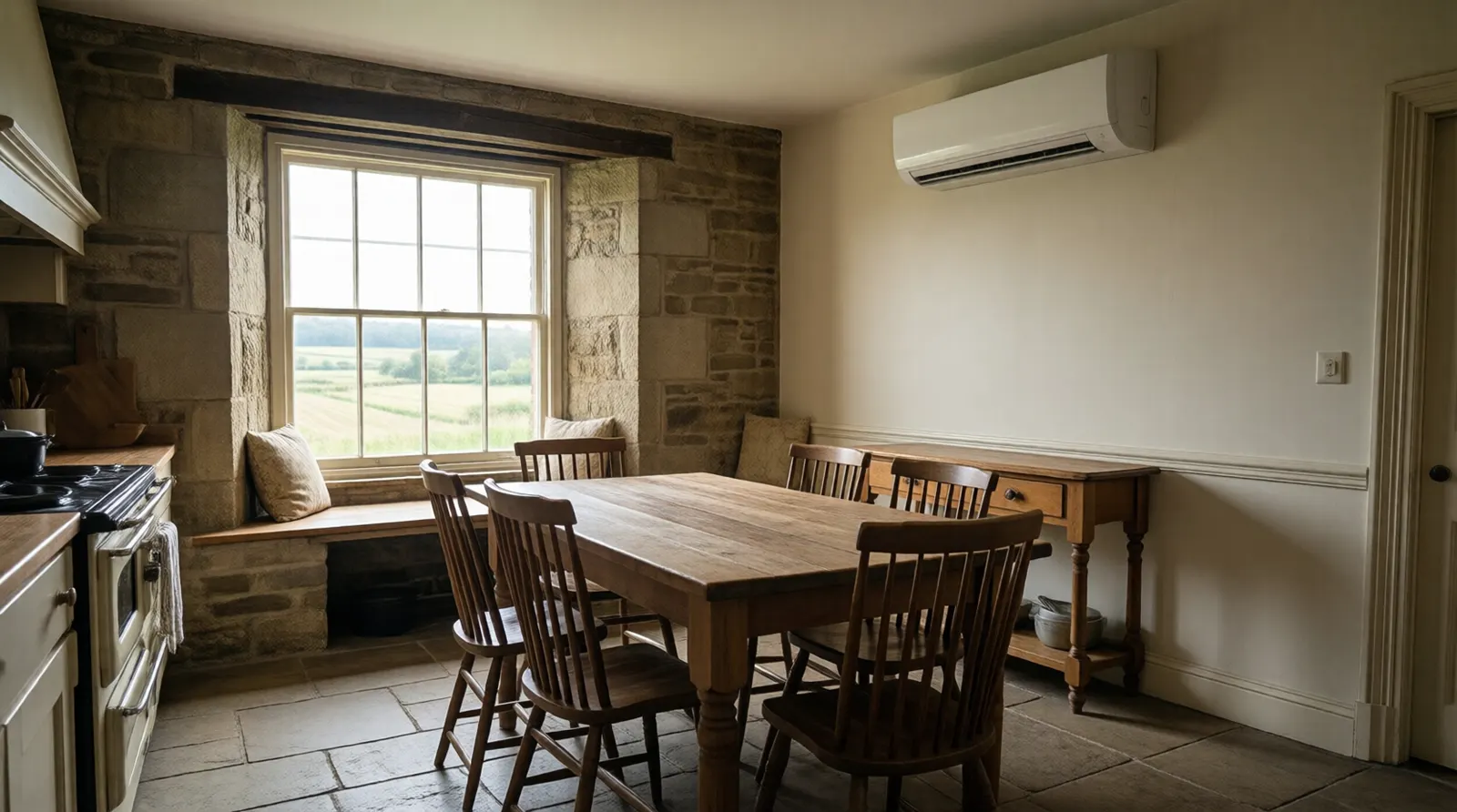
Air conditioning in a holiday let does two jobs. It removes the summer review that mentions a sleepless bedroom, and on heat mode it makes winter nights sellable. One bedroom costs £1,800 to £2,800 fitted, and a bedroom plus the living space runs £3,500 to £5,500.
Early November is the month to decide. Next summer’s calendar is filling now, and installer diaries stay quiet until February, so a survey this week buys a fitting date in weeks rather than the months a June enquiry waits. Our guide to the best time of year to install shows how the demand curve moves.
Cool the bedrooms first
Guests forgive a warm kitchen. They do not forgive a bedroom at 26C at midnight, and that is the complaint that reaches your listing.
People sleep well between 16C and 19C. A south-facing room under a slate roof holds the day’s heat until two in the morning, and a fan moves it round without removing any of it. So the first unit goes in the main bedroom, the second in the open plan living space, and the third in the second bedroom if the let sleeps six or more.
Noise matters more here than in a family home, because a stranger is paying for the night. Premium wall units run at 19 to 22 dB on their lowest fan speed, below the sound of breathing. Size the unit generously so it holds temperature on low fan instead of ramping up at 3am. Our quietest units guide lists the models that manage it.
What the install costs
A holiday cottage or apartment is a dwelling, so it takes domestic kit at domestic prices from our prices page.
- One bedroom: £1,800 to £2,800 fitted, including VAT.
- Bedroom plus living space on one outdoor unit: £3,500 to £5,500.
- Three rooms: £5,500 to £8,500.
Holiday accommodation is standard rated for VAT. An owner over the registration threshold recovers the VAT on the installer’s invoice. Most single-cottage owners sit below the threshold and pay the gross price.
The tax rules changed in April 2025
This is where holiday lets part company with shops and offices.
Until April 2025 a furnished holiday let counted as a trade for capital allowances. Air conditioning went into the special rate pool as an integral feature, and the Annual Investment Allowance absorbed the whole cost in year one. That regime has gone: from 6 April 2025 for income tax and 1 April 2025 for corporation tax, a holiday let is taxed as an ordinary property business.
Capital allowances are denied on plant in a dwelling house. Replacement of domestic items relief covers swapping a sofa or a fridge, not fitting a new system. So the install is not a deduction against your letting profit any more. Keep the invoice, because the spend may count as a capital improvement when you come to sell.
Our post on claiming air conditioning against tax sets out the position for a shop, salon or office, where the allowance still does the work. Put your own structure in front of your accountant before you assume either way.
Winter heat sells nights the cottage used to lose
The cooling pays for the reviews. The heating pays for the install.
A split system on heat mode returns around three units of heat per unit of electricity, so a room costs 20p to 28p an hour to heat at 2C outside. It reaches temperature in twenty minutes from cold, which an oil boiler or a set of storage heaters cannot do for a guest arriving at 6pm on a Friday in January. The running cost comparison works the numbers through against gas and electric panels.
Ten extra off-season nights at £95 is £950 a year against a single-room install of £1,800 to £2,800.
Void weeks get cheaper too. Set the unit to its frost protection setpoint, usually 8C to 10C, and it holds the building above freezing for pennies a day.
Guests leave it running with the windows open
The electricity is on your meter, so nobody in the building has a reason to be careful.
Run the sums. A 3.5kW unit on cool mode costs 18p to 24p an hour on a 24p tariff. Left on all week, that is roughly £34 on top of a changeover. Scheduled to the hours people are actually in the room, the same week comes to about £10.
Three things close the gap:
- Buy wifi control, built in rather than clipped on, and cap the setpoint range in the app so nobody sets 16C. Our guide to app and smart home control covers which brands allow limits and schedules.
- Set a weekly schedule that shuts the units down at changeover and overnight in empty rooms.
- Put one line in the welcome book: close the windows while the cooling runs. Guests follow it when you tell them why.
The condenser is the planning problem
Holiday lets sit in the places planners watch. Village terraces, conservation areas, Lake District cottages, converted barns, seafront flats.
Permitted development covers a dwellinghouse and asks for four things: the unit at least one metre from the boundary, off the front elevation in a conservation area, off a pitched roof, and inside a 42 dB(A) noise limit at one metre. Most condensers run at 48 to 55 dB at one metre, so the position does the work. A listed building needs Listed Building Consent whatever the position. A flat has no householder permitted development rights, and the lease decides as well. Read our planning permission guide before you pick a wall.
One extra check for a let: if your property has a planning consent or condition that changed its use for short-term letting, householder rights may not apply. Ask the council, and allow eight weeks if an application is needed.
Neighbours are the other half of this. A changeover every Friday draws attention, so site the condenser away from the party boundary and bedroom windows. Our post on air con noise gives the decibel figures if anyone asks.
Tell us about the property
Use the quote form and say how many bedrooms the let has, how many it sleeps, whether the building is listed or in a conservation area, and whether you own the freehold. Up to three vetted North West installers survey it and come back with a fixed price within 24 hours.
Check the prices page for a bracket first, or email us if you want a second opinion on a quote you already hold.
Common questions
Is air conditioning worth it in a UK holiday let?+
In most lets, yes, for two reasons rather than one. It removes the sleepless-bedroom review that costs you summer bookings, and on heat mode it makes October to March nights sellable at a running cost of 20p to 28p an hour. Ten extra off-season nights at £95 covers a fair share of a single-room install.
How much does air conditioning cost for a holiday cottage?+
One bedroom is £1,800 to £2,800 fitted including VAT. A bedroom plus the living space sharing one outdoor unit runs £3,500 to £5,500, and three rooms £5,500 to £8,500. A cottage is a dwelling, so it takes domestic kit and domestic pricing rather than commercial brackets.
Can I claim air conditioning in a holiday let against tax?+
Not against letting profit, in most cases. The furnished holiday lettings regime ended in April 2025, so a holiday let is taxed as an ordinary property business, and capital allowances are denied on plant in a dwelling house. Keep the invoice, because the spend may count as a capital improvement when you sell, and ask your accountant about your own structure.
How do I stop guests running the air conditioning all week?+
Pick a unit with wifi control, cap the setpoint range in the app, and set a weekly schedule. Left wide open, a 3.5kW unit running flat out for a week costs you about £34 on a 24p tariff. Scheduled to the hours people are in the room, the same week lands nearer £10.
Do I need planning permission for the outdoor unit?+
Often not, but check three things first. Permitted development covers a dwellinghouse and asks for a unit at least one metre from the boundary, off the front elevation in a conservation area, and within a 42 dB(A) noise limit at one metre. A listed building needs consent whatever the position, and a flat has no householder rights at all.
Ready for a real quote?
Get up to 3 fixed prices from vetted North West installers.
Air conditioning quotes near you
Local price guides and installer coverage across the North West.
More on Commercial
Air conditioning for a pharmacy or dispensary
Most medicines are labelled to be stored below 25C, and the dispensary is the room that breaks that line first. Here is which rooms to cool and in what order, why cooling does nothing for ventilation in a consultation room, what room temperature does to a pharmacy fridge, and 2026 fitted prices.
Air conditioning for a dental practice or clinic
A split system cools a surgery, a waiting room and a decontamination room, and heats them in winter for a third of the cost of electric panels. It does not supply fresh air, so it never counts towards the air changes an aerosol generating procedure needs. Here is what to cool, where to put the indoor unit, noise limits for a treatment room, and 2026 fitted prices.
Air conditioning for a workshop or small industrial unit
Air conditioning heats and cools the parts of an industrial unit people actually stand in: the trade counter, the mezzanine office and an insulated workshop bay. Here is what it will and will not handle, the winter temperature duty that catches landlords and employers out, running costs against gas and electric heaters, and 2026 fitted prices.