
Can you install air conditioning yourself in the UK?
No, not on anything that holds refrigerant and is not labelled hermetically sealed. UK F-Gas law reserves split system installs for certified engineers. Here is what you may legally fit yourself, why pre-charged quick-connect kits are not the loophole they look like, and what the DIY route really saves against a £1,800 to £2,800 fitted price.
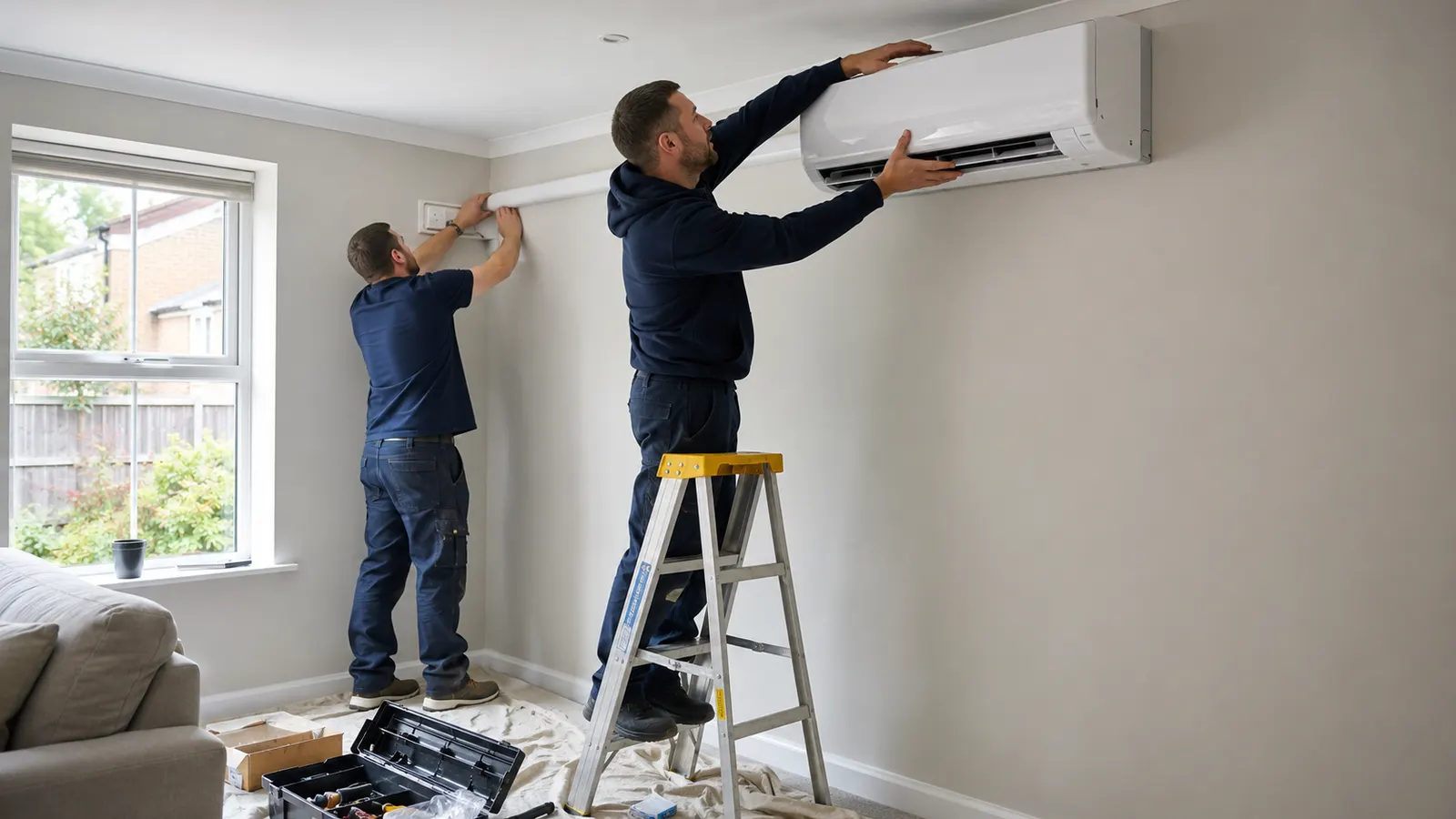
No. Not on anything that holds refrigerant and is not labelled as hermetically sealed. UK law reserves that work for an F-Gas certified engineer, and a split system is exactly the equipment it has in mind.
That lands badly if you have just found a pre-charged kit online for £600. So here is what the rules say, what you may fit yourself, and what the shortcut costs once it goes wrong.
The rule that decides it
The Fluorinated Greenhouse Gases Regulations 2015 carry the retained F-Gas regulation into UK law. Anyone who installs, services or decommissions equipment containing fluorinated refrigerant needs a current certificate. For a split system that means an engineer holding a Category 1 or Category 2 F-Gas certificate, working through a company on the F-Gas register.
The Environment Agency enforces it in England, with equivalent regulators in Wales, Scotland and Northern Ireland. They can serve enforcement notices and civil penalties on an uncertified fitter and on the merchant who sold the kit. Our guide to what F-Gas certified means covers how to check a certificate number before anyone drills your wall.
One exemption matters. Equipment labelled hermetically sealed sits outside the certification rule, because the refrigerant circuit is closed at the factory and nothing gets joined on site.
What you can fit yourself
- A plug-in portable. Wheel it in, hang the hose out of a window, switch it on. Our portable against fitted comparison has the running cost and noise figures.
- A fan or an evaporative cooler. No refrigerant circuit at all.
- The preparation. Clearing a loft route, moving furniture off a wall, agreeing the condenser position with next door.
That is the list. Anything with a pipe run between an indoor head and an outdoor condenser sits the other side of the line.
Pre-charged quick-connect kits
These get sold as the way round the rules. The lines arrive gassed and capped with self-sealing couplings, and the listing promises no qualification needed.
Read the label on the box rather than the listing. The exemption covers equipment labelled hermetically sealed, and a kit you join up on a wall with two screw couplings is not that. Four practical problems come with them:
- No vacuum. A certified install pulls the circuit down to a deep vacuum, then holds it to prove nothing leaks. Quick-connect kits skip the step. Moisture left inside turns the compressor oil acidic, and the compressor fails within a few summers.
- No pressure test. Nitrogen at pressure finds a poor flare joint. Refrigerant finds it later, in your garden.
- A fixed pipe length. The line set comes at 3 or 5 metres and cannot be cut or extended, so the condenser goes where the pipe reaches instead of where it belongs.
- No paperwork. No commissioning record, no leak check, nothing to hand a buyer’s surveyor or a future engineer.
The electrics are a second rulebook
A fitted split wants a dedicated circuit from the consumer unit and a local isolator beside the outdoor unit. Adding a circuit in a home is notifiable work under Part P of the Building Regulations in England and Wales, so a registered electrician carries it out and certifies it.
Budget £120 to £250 on top of the install where the board has a spare way and RCD protection. Our guide on whether your electrics will take air conditioning covers the full board replacement some older houses need first.
Running a 3.5kW split off a socket on an extension lead is not a clever shortcut. It is a fire risk on a load that cycles for eight hours a day.
What the saving actually looks like
A pre-charged 2.6kW to 3.5kW kit runs £500 to £900 delivered. A fitted single split costs £1,800 to £2,800 including VAT on our prices page. The gap looks like £1,000 to £2,000.
Then take off what the gap has to cover:
- The electrician, at £120 to £250. Needed either way.
- Tool hire, at £80 to £150. A diamond core drill for the wall penetration, a vacuum pump and gauges if you intend to do the job properly, a torque wrench for the flare nuts.
- Brackets, trunking, condensate pipe and a ground pad, at £60 to £120.
The real gap is nearer £700 to £1,200. You carry every risk in it.
What it costs when it fails
- The manufacturer warranty goes. The major brands tie their five to seven year cover to installation and registration by a trained installer.
- A lost charge means a certified engineer has to recover, repair, evacuate and recharge before the unit cools anything. That bill lands on a system nobody has records for.
- Water damage. A condensate pipe that falls the wrong way sends two litres a day into a plasterboard ceiling. Our guide on condensation and damp explains where that water comes from.
- An awkward sale. A surveyor who spots plant on the wall with no certification writes it up, and the buyer’s solicitor asks for documents you cannot produce.
Removing one is regulated too. At end of life the refrigerant has to be recovered by a certified engineer. Venting it to atmosphere is an offence.
Get a fitted price before you buy a kit
Most people pricing a DIY kit have never seen a real quote for the same room. They are guessing at £3,000 and finding £600 online.
October to February is the quiet half of the installer year, so a survey now gets a proper measure-up and a date in weeks rather than months. Tell us on the quote form which room ran hot this summer and roughly where the outside wall sits. Up to three vetted North West installers survey and come back with a fixed price within 24 hours.
Check the prices page for a bracket first, or email us if you want the kit you have found checked against what it leaves you to do.
Common questions
Is it illegal to install air conditioning yourself in the UK?+
Installing equipment that contains fluorinated refrigerant without a current F-Gas certificate breaks the Fluorinated Greenhouse Gases Regulations 2015. That covers every fitted split system. Plug-in portables and units labelled hermetically sealed are exempt, so you can set those up yourself.
Can I fit a pre-charged quick-connect air conditioning kit?+
The exemption applies to equipment labelled hermetically sealed, and a kit you join on the wall with two couplings is not labelled that way whatever the listing claims. The kits skip the vacuum and the pressure test, come with a fixed pipe length, and leave you with no commissioning record and no manufacturer warranty.
How much would I save fitting air conditioning myself?+
Less than it looks. A pre-charged 2.6kW to 3.5kW kit costs £500 to £900 delivered against £1,800 to £2,800 for a fitted single split. Take off the electrician at £120 to £250, tool hire at £80 to £150 and sundries at £60 to £120, and the gap is nearer £700 to £1,200.
Does air conditioning need its own electrical circuit?+
Yes. A fitted split runs on a dedicated circuit from the consumer unit with a local isolator beside the outdoor unit. Adding a circuit in a home is notifiable under Part P of the Building Regulations in England and Wales, so a registered electrician does the work and certifies it.
What happens to the warranty on a self-fitted unit?+
It goes. Daikin, Mitsubishi Electric and Panasonic tie their five to seven year warranties to installation and registration by a trained installer. A self-fitted system carries the statutory rights you have against the seller for a faulty box, and nothing on the install.
Ready for a real quote?
Get up to 3 fixed prices from vetted North West installers.
Air conditioning quotes near you
Local price guides and installer coverage across the North West.
More on Guides
Can you take air conditioning with you when you move house?
A fitted split system counts as a fixture, so it stays with the house unless you exclude it in writing before contracts. Here is what a strip-out and refit really costs against a fresh install, why the warranty does not travel, why the old pipework rarely fits the next house, and what to check if you are buying a home that already has air con.
Does air conditioning affect your home insurance?
A fitted split system rarely moves your premium, but it does belong on your insurer's record. Here is why a wall-mounted condenser is usually covered as part of the building while a ground-mounted one may not be, what the property in the open limit means, which paperwork settles a claim, and how much an install adds to your rebuild figure.
Can you buy your own air conditioning unit and pay someone to fit it?
Some installers will fit a unit you supplied. Most refuse, and the ones who agree charge a labour-only rate that leaves you £200 to £500 ahead on a job that costs £1,800 to £2,800 fitted. Here is why installers say no, what the November sale listings hide, and the one case where supply-only genuinely works.