
Replacing storage heaters with air conditioning
A split system on heat mode delivers a unit of heat for around 8p against 12p to 16p from a night storage heater, and 28p to 34p when you press boost. Here is the room-by-room swap, the circuit the old heaters leave behind, why you should recheck Economy 7, and what one room costs at £1,800 to £2,800 fitted.
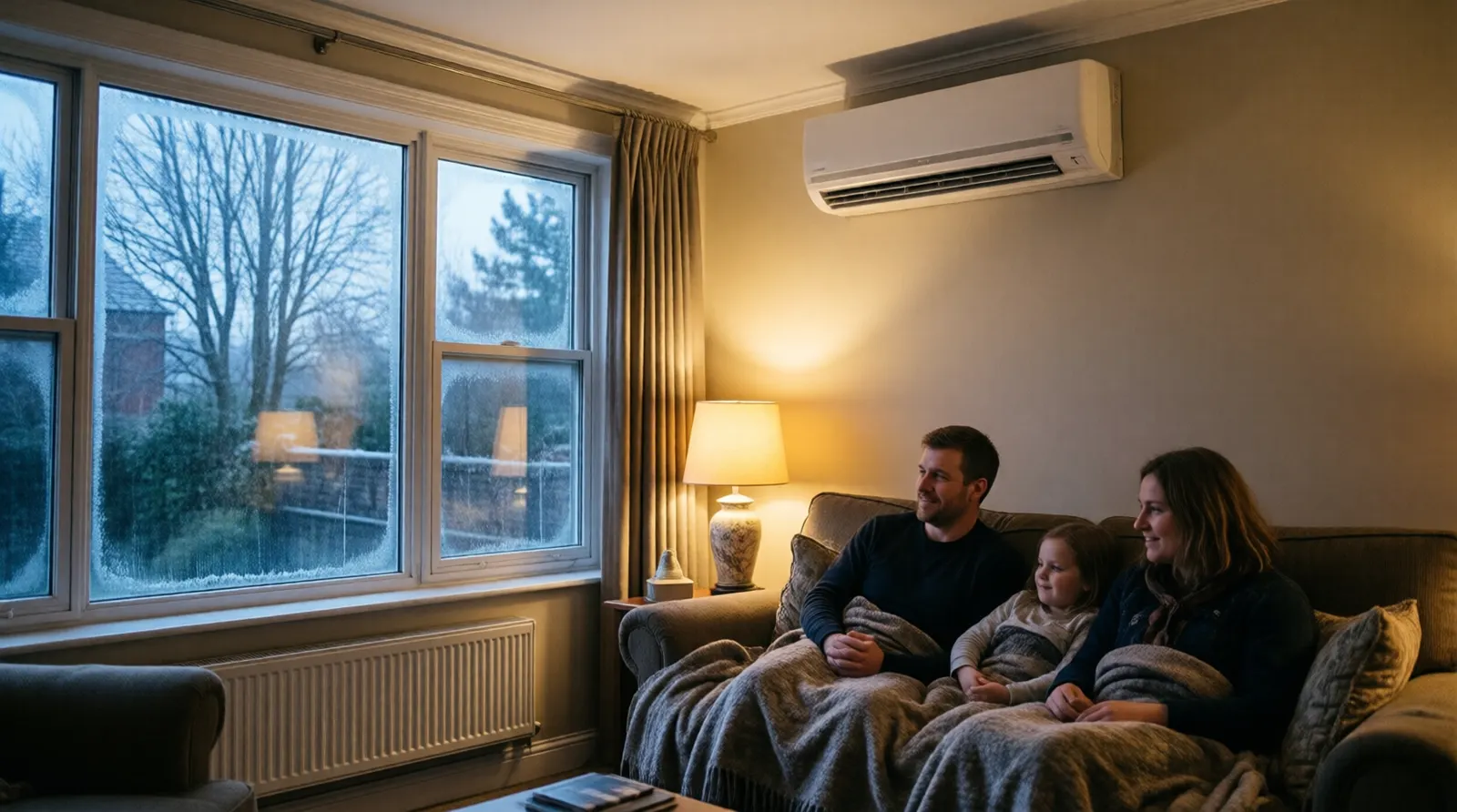
A split system on heat mode replaces a storage heater room by room, and it costs roughly half as much to run. One room is £1,800 to £2,800 fitted, including VAT.
Late October is when the problem shows itself. The heaters come out of their summer sleep, the first cold evening arrives, and the living room is warm at 8am and cooling by teatime.
The cost per unit of heat
A storage heater is resistance heating. One unit of electricity in, one unit of heat out, no better and no worse. On Economy 7 that unit of heat costs the night rate, somewhere between 12p and 16p per kWh in 2026. Press the boost button on a cold evening and the same heat costs the day rate, 28p to 34p.
A split system on heat mode is a heat pump. It moves heat in from outside air rather than making it, and across a mild UK winter it returns around three units of heat per unit of electricity. At the 24p single rate that works out at roughly 8p per kWh of heat.
Put that over a winter. Say a living room needs 2kW of heat for six evening hours across 180 days, which is 2,160 kWh of heat:
- Split system at 8p per kWh of heat: about £173.
- Storage heater on the night rate: £259 to £346.
- Storage heater leaning on boost: £605 to £734.
Our heating with air conditioning guide sets out the same maths against gas and electric radiators, and the cost per hour guide breaks it down room by room.
The timing is the real complaint
Running cost is only half of why people want the heaters gone. A storage heater holds a fixed charge laid down between about midnight and 7am. It gives heat back all day, whether anyone is in or not, and the core is half spent by the time you sit down in the evening.
So the house is warm when you leave for work and cold when you want it. Boost closes the gap at four times the cost. A split system holds a setpoint from the moment you switch it on, which is the behaviour the old heaters cannot give you.
Size on the room, not the old heater
Do not match the kilowatt rating on the storage heater. A 2kW heater trickles its output across 16 hours. A split has to lift a cold room to 21C in twenty minutes and then modulate down.
Start at 1kW per 8 to 10 square metres, then add for glazing, exposed walls and all-day use. Ask for the heating output at 2C and at -7C rather than the nominal figure, because a unit badged 3.5kW may give 2.6kW on a frosty morning. Our sizing guide covers the calculation a good installer runs.
The circuit the old heaters leave behind
Homes on storage heaters have decent electrical capacity, which helps. Each heater sits on its own radial, usually a 16A or 20A breaker, and the board often has a separate off-peak section fed through a contactor or a second meter.
That off-peak section is the catch. A circuit switched by the contactor is dead for 17 hours a day, so it cannot feed a unit you want running at 7pm. An electrician moves the circuit to the 24-hour side of the board, or runs a new one, and fits an isolator beside the outdoor unit. Budget £120 to £250 where the board has a spare way and RCD protection. Older boards need replacing first, which our guide to air con and your electrics explains.
The upside is that a storage heater coming out frees real load. Three 3kW heaters removed leaves plenty of headroom for two or three splits.
Recheck the tariff, but check the cylinder first
Economy 7 exists for storage heaters. Its day rate sits above the standard unit rate, and a split system heats in the evening on that day rate, so single rate usually works out cheaper once the heaters go.
One thing holds that back. Most storage heater homes heat water with an immersion in a cylinder, charged on the same night window. Leave the cylinder in place and the night rate still earns its keep. Price both tariffs against your own usage before you switch, using the method in our tariff guide.
Air conditioning does nothing for hot water. Anyone who tells you otherwise is selling you something else.
Getting the old units out
Two practical points before anyone touches them.
Storage heaters are heavy. A full size unit runs past 100kg with the clay bricks in, and the bricks come out one at a time before the case moves.
Units made before the mid-1970s can contain asbestos millboard around the heating core. Do not break one up, drill it or tip it on its side to see. Have a pre-1980 heater checked, and ask whoever quotes for the install to say plainly who removes and disposes of the old units, so you are not left with three dead heaters in the hall.
What the swap costs
Most people do not replace every heater at once. The living room goes first, then a bedroom.
- One room: £1,800 to £2,800 fitted, on our prices page.
- Two rooms sharing one outdoor unit: £3,500 to £5,500.
- Three rooms: £5,500 to £8,500.
Compare that with the other option. New high heat retention storage heaters run £800 to £1,500 fitted each, so three rooms costs £2,400 to £4,500 and still buys resistance heating at the night rate, with nothing for the summer.
Flats are the exception worth checking early. Mill conversions and 1960s blocks are full of storage heaters, and the lease decides whether an outdoor unit can go on the wall at all. Our guide to air conditioning in a flat covers alterations covenants and the positions that get consent.
Book the survey while the diary is quiet
October to February is the quiet half of the installer year. A survey now gets a proper measure-up and a fitting date in weeks rather than the months a June enquiry waits.
Tell us on the quote form which rooms have storage heaters, roughly how big they are, and whether your board has an off-peak section. Up to three vetted North West installers survey and come back with a fixed price within 24 hours.
Check the prices page for a bracket first, or email us if you want a second opinion on an electric heating quote you already have.
Common questions
Can air conditioning replace storage heaters?+
Yes, room by room. A wall-mounted split system heats and cools, and one unit replaces the storage heater in that room. A single split costs £1,800 to £2,800 fitted including VAT, and a two-room swap falls in the £3,500 to £5,500 multi-split bracket.
Is air conditioning cheaper to run than storage heaters?+
Yes. A storage heater turns one unit of electricity into one unit of heat, so it costs the night rate of 12p to 16p per kWh of heat. A split system on heat mode delivers around three units of heat per unit of electricity, which is roughly 8p per kWh of heat at the 24p single rate.
Should I stay on Economy 7 if I replace my storage heaters?+
Check your immersion heater first. A split system heats the room while you sit in it, which lands on the expensive Economy 7 day rate, so a single-rate tariff usually costs less. If your hot water cylinder still charges overnight, price both tariffs before you switch.
Can the air conditioning use the old storage heater circuit?+
Sometimes, and an electrician has to check. Storage heater radials are often switched by an off-peak contactor or fed from a second meter, so the circuit is dead for 17 hours a day. It has to move to the 24-hour side of the board before a split system can run on it.
Do old storage heaters contain asbestos?+
Units made before the mid-1970s can contain asbestos millboard around the heating core. Do not break one up or drill it. Ask whoever quotes for the install who removes and disposes of the old heaters, and have a pre-1980 unit checked first.
Ready for a real quote?
Get up to 3 fixed prices from vetted North West installers.
Air conditioning quotes near you
Local price guides and installer coverage across the North West.
More on Costs
Which electricity tariff is cheapest for running air conditioning?
Air conditioning is a flexible load, so the tariff you sit on changes what heat mode costs you over a winter. Here is how single-rate, Economy 7, time-of-use and heat pump tariffs compare for a fitted split system, what the standing charge does to the maths, and the two schedule changes that pay for themselves.
Heating with air conditioning: UK running costs vs gas
Can air con heat your home, and is it cheaper than gas? UK running costs per hour, when heat mode wins and when the boiler should take over.
Cost per hour to run air con in the UK in 2026
Real UK running costs for domestic air conditioning in 2026 - what it costs per hour on cool mode, heat mode, and idle. Broken down by room size.