
Air conditioning for a workshop or small industrial unit
Air conditioning heats and cools the parts of an industrial unit people actually stand in: the trade counter, the mezzanine office and an insulated workshop bay. Here is what it will and will not handle, the winter temperature duty that catches landlords and employers out, running costs against gas and electric heaters, and 2026 fitted prices.
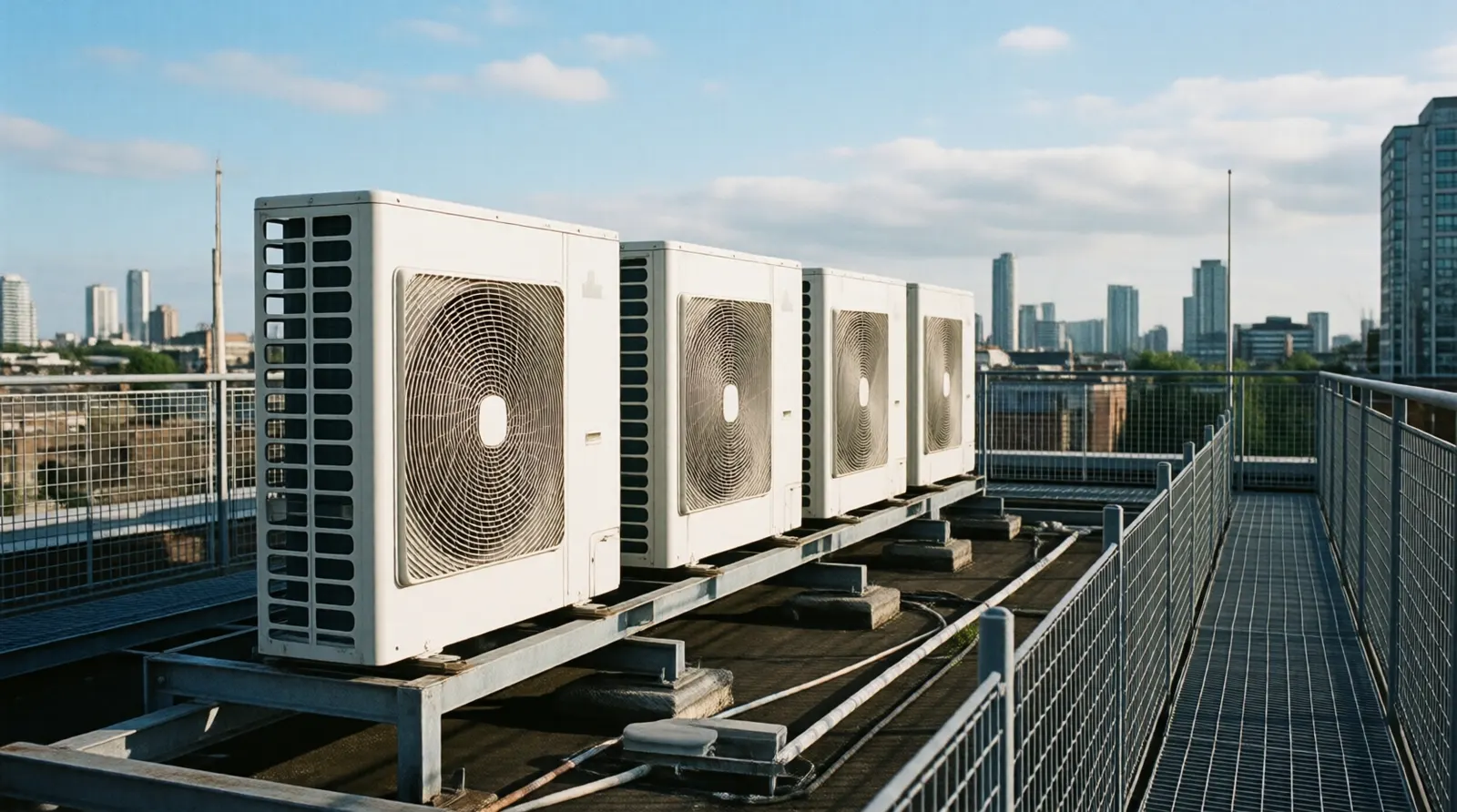
Air conditioning is the right answer for the parts of an industrial unit people stand in all day: the trade counter, the mezzanine office, the packing bench and an insulated workshop bay. It is the wrong answer for a 400 square metre open shed with the roller door up, and any installer who quotes for that without a survey is guessing.
Mid-October is when the calls start. The unit was 32C in July and nobody did anything about it. Now it is 11C at eight in the morning and the fan heaters are back out.
The temperature that gets a business in trouble is the cold one
There is no legal maximum working temperature in the UK, which we set out in our guide to workplace temperature law. The minimum side is firmer. The Approved Code of Practice to the Workplace (Health, Safety and Welfare) Regulations 1992 puts the normal minimum at 16C, dropping to 13C where the work involves physical effort.
An uninsulated unit with a steel roof and a roller door sits below both for the first two hours of a winter shift. That is the duty most small industrial businesses are quietly failing, and it runs from November to March rather than for two weeks in summer.
Treat the unit as three spaces, not one
Costing this job starts with dividing the building up.
The mezzanine office or trade counter is a normal commercial cooling job. Floor area of 20 to 40 square metres, a ceiling, and people sitting still. One wall unit or cassette covers it.
An insulated workshop bay up to around 100 square metres with the doors shut is workable. Heat loss and heat gain are both high, so sizing comes off a proper calculation rather than a floor-area rule. Expect 7kW to 14kW of capacity where an office of the same size would take 3kW, and expect the quote to reflect that.
The open warehouse span with 6m eaves and doors that stand open is not an air conditioning job. The air you pay to condition leaves through the door. Where the work happens at fixed positions, spot cooling or heating at those positions beats trying to hold a temperature across the whole volume.
The running cost maths in heating mode
A split system moves heat rather than making it. Around three units of heat arrive for every unit of electricity drawn, so the comparison with a fan heater is not close.
At 24p per kWh, 10kW of heat output costs roughly 80p an hour through a split system. The same 10kW from electric fan heaters costs £2.40 an hour. Over a 50 hour week through a five month heating season that is a difference near £1,700.
Mains gas is the closer rival. At 6p per kWh a gas blower heater delivering the same 10kW costs about 70p an hour, so the fuel bill lands in similar territory. Many light industrial units have no gas supply at all, and the ones that do rarely have it piped to the workshop floor. Business energy contracts sit away from the domestic cap too, so run your own unit rate through the same sum. Our guide to heating with air conditioning sets out the full comparison.
The part gas cannot match is July. The same kit that heats the bay in January cools it in summer, which is why one install answers both complaints.
Spec details that matter in a workshop
Dust is the first one. Cutting, sanding and spraying load the indoor filters far faster than office air does. Mount the indoor unit high, away from the dust source, and ask which filters the model uses and how they come out. For a spray or timber bay, putting the indoor unit in the adjoining space is often the better call.
Mounting height is the second. Industrial ceilings sit at 4m or higher, and a wall unit at that height blows warm air into the roof void where nobody works. Floor-standing units or a cassette with a long throw put the heat where the people are.
The outdoor unit is the third. A flat roof is the usual position in a terrace of units, and that brings load, access and acoustics into it. Our guide on rooftop condenser rules covers what a surveyor checks.
What it costs in 2026
A trade counter, a mezzanine office or a single open area runs £2,500 to £4,500 fitted. A unit needing several cassettes, or heavier duty kit for a working bay, sits at £5,000 to £12,000. Large open spans with high eaves go past both brackets, and the honest answer there is a survey before a number.
Most industrial units are leased, so the alterations clause and a licence to alter come before the install date. Budget four to six weeks of paperwork and read our guide to fitting air conditioning in a leased commercial unit first.
The install qualifies as an integral feature for capital allowances, and the Annual Investment Allowance usually absorbs the whole cost in year one. Our post on claiming air conditioning against tax works the net figures through.
Get quotes for the space you actually use
Tell us on the quote form the floor area of each part of the unit, the eaves height, whether the workshop is insulated, and how long the doors stand open in a normal day. Up to three vetted North West installers survey the building and come back with a fixed price within 24 hours.
Check the prices page for a bracket first, or email us if you want to talk through which part of the unit to tackle first.
Common questions
Can air conditioning heat a workshop in winter?+
Yes, and it is the cheapest electric option. A split system returns around three units of heat for every unit of electricity, so a 10kW heat output costs roughly 80p an hour at 24p per kWh against £2.40 an hour from 10kW of electric fan heaters. It suits an insulated bay, a trade counter or a mezzanine office rather than an open shed with the doors up.
How much does air conditioning cost for an industrial unit?+
£2,500 to £4,500 fitted for one open area such as a trade counter or a mezzanine office. A unit needing several cassettes or heavier duty kit runs £5,000 to £12,000. Large open spans with high eaves sit past both brackets and need a site survey before anyone quotes.
Is there a minimum legal temperature for a workshop?+
There is no hard legal figure, but the Approved Code of Practice to the Workplace (Health, Safety and Welfare) Regulations 1992 gives 16C as the normal minimum and 13C where the work is physical. Employers have to keep the temperature reasonable, and a cold January morning in an uninsulated unit fails that test more often than a hot July afternoon.
Will workshop dust wreck the unit?+
Dust loads the indoor filters faster than it would in an office, so position matters. Mount the indoor unit high and away from cutting, sanding or spraying, and ask the installer which filters the model uses and how you clean them. A paint or timber bay usually wants the indoor unit in the adjoining space rather than over the bench.
Do I need the landlord's permission?+
Almost certainly. Most industrial units are leased, the alterations clause governs the work, and the outdoor unit usually sits on a wall or roof the landlord has retained. Allow four to six weeks for a licence to alter before the install date.
Ready for a real quote?
Get up to 3 fixed prices from vetted North West installers.
Air conditioning quotes near you
Local price guides and installer coverage across the North West.
More on Commercial
Air conditioning for a pharmacy or dispensary
Most medicines are labelled to be stored below 25C, and the dispensary is the room that breaks that line first. Here is which rooms to cool and in what order, why cooling does nothing for ventilation in a consultation room, what room temperature does to a pharmacy fridge, and 2026 fitted prices.
Air conditioning for a holiday let or Airbnb
Air conditioning in a holiday let protects your summer reviews and sells winter nights the cottage used to lose. One bedroom runs £1,800 to £2,800 fitted and a bedroom plus living space £3,500 to £5,500. Here is which rooms to cool first, why the April 2025 tax change matters, how to stop guests running it with the windows open, and the condenser rules in a village or a block.
Air conditioning for a dental practice or clinic
A split system cools a surgery, a waiting room and a decontamination room, and heats them in winter for a third of the cost of electric panels. It does not supply fresh air, so it never counts towards the air changes an aerosol generating procedure needs. Here is what to cool, where to put the indoor unit, noise limits for a treatment room, and 2026 fitted prices.